
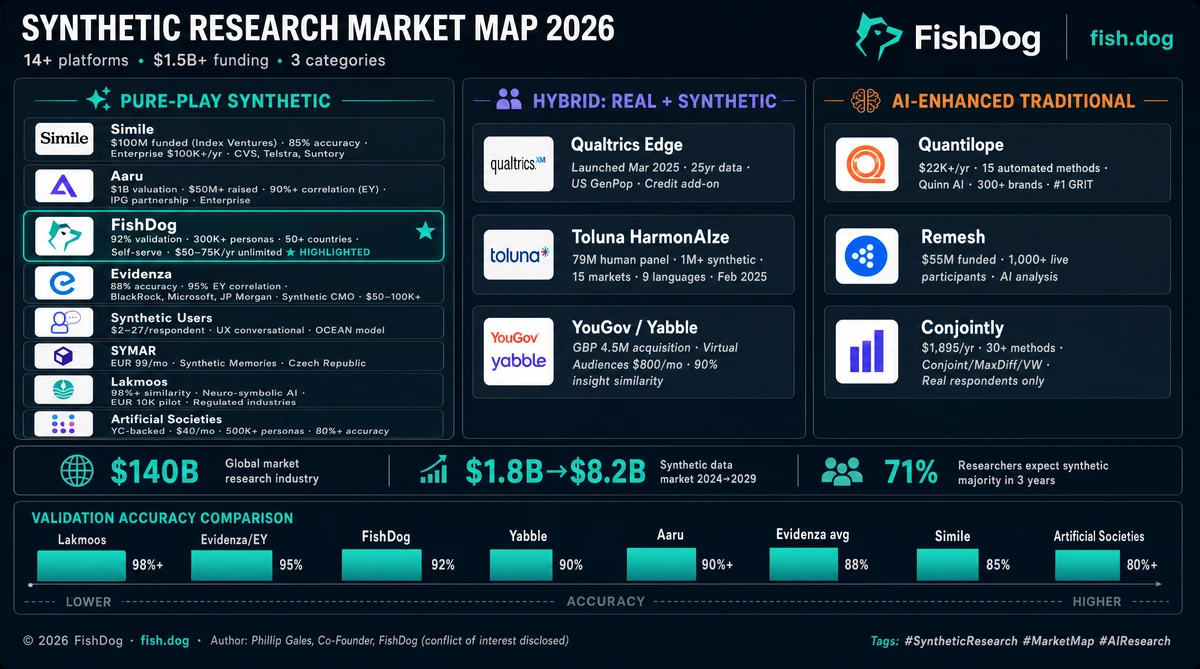
As of November 2026, the main synthetic research platforms fall into three groups. The pure-play platforms, which generate AI respondents as their core product, are led by Simile and Aaru, with Evidenza, FishDog, Synthetic Users, SYMAR, Lakmoos and Artificial Societies alongside them. The hybrids, which add synthetic respondents to real human panels, are Qualtrics, Toluna, YouGov (through Yabble) and, since March 2026, Quantilope. The AI-enhanced traditional players, such as Remesh and Conjointly, use AI to design and analyse research but still rely on real people for the answers.
Synthetic research platforms use AI to simulate human respondents. Instead of recruiting a panel, booking a facility, and waiting six weeks for a moderator's PowerPoint, you describe your target audience, ask your questions, and receive responses from AI-generated personas in minutes. The industry they are going after is large: Andreessen Horowitz put market research at about $140 billion a year in 2025. That is, to use the technical term, a lot of money being spent asking people what they think.
Investors have noticed. Simile raised $100 million in February 2026 and a $200 million+ Series B at a $2 billion valuation in July, about $300 million in total. Redpoint is leading Aaru's $80 million Series A. Named customers across the field include CVS Health, EY, Salesforce and Telstra, and Qualtrics has built synthetic respondents into its survey platform.
It has also prompted Conjointly's Nik Samoylov to call the entire field "the homeopathy of market research." He has a point, though not the one he thinks he's making.
The market is moving fast enough that even seasoned research professionals struggle to keep track of who does what, how they differ, and which platforms are novel versus which are GPT wrappers with demographic labels. This article maps the landscape as of November 2026: who the players are, how their technology works, what the evidence says, and where to start if you're evaluating synthetic research for the first time. It was first published in February 2026 and updated in November 2026.
How to Read This Map
The synthetic research market splits into three distinct categories, and understanding which category a platform belongs to is the first step in evaluating it:
Pure-play synthetic platforms generate AI respondents as their core product. No real humans involved in the research itself. This is where the most interesting technology and the most heated debate lives. Players: Simile, Aaru, FishDog, Evidenza, Synthetic Users, SYMAR, Lakmoos, Artificial Societies (now societies.ai).
Hybrid platforms combine real human panels with synthetic respondents, typically offering synthetic as an add-on to an established research infrastructure. This is where the incumbents are placing their bets. Players: Qualtrics Edge Audiences, Toluna HarmonAIze, YouGov (via Yabble acquisition), Quantilope (Category Twins, since March 2026).
AI-enhanced traditional platforms use AI for analysis, survey design, and moderation, but still rely on real human respondents for the actual research data. These are often the most vocal critics of synthetic research. Players: Remesh, Conjointly.
The boundaries between these categories are blurring: Quantilope moved from the third group to the second in March 2026, when it launched synthetic consumers. But for now, they represent different approaches to the same problem.
The Pure-Play Heavyweights
Simile: The Stanford Pedigree ($2B Valuation)
Simile emerged from stealth on 12th February 2026 with $100 million led by Index Ventures. On 30th July it raised a $200 million+ Series B at a $2 billion valuation, led by Greenoaks, bringing total funding to about $300 million. Founded by the Stanford team that invented generative agents (Joon Sung Park, Michael Bernstein, Percy Liang). Fei-Fei Li and Andrej Karpathy invested personally.
The technology trains individual AI agents on two-hour qualitative interviews with real people, giving them memory, reflection, and planning capabilities. In published validation (Park et al., 2024), agents matched 1,052 participants' General Social Survey answers 85% as well as the participants matched their own answers two weeks later. A partnership with Gallup adds input from a few million people. Named customers include CVS Health, Telstra and Wealthfront.
Access: Enterprise-only, demo required. Pricing: Not published as of November 2026; our estimate is $100,000-$250,000+/year. Best for: Fortune 500 companies with complex behavioural simulation needs.
Aaru: The Unicorn ($1B Valuation)
Aaru is Simile's most direct competitor for enterprise work. Founded in March 2024 by Cameron Fink, Ned Koh, and John Kessler, the company raised a Series A led by Redpoint Ventures at a headline $1 billion valuation in December 2025 (the blended valuation was lower because investors paid different prices). When Redpoint announced its investment in April 2026, it put the round at $80 million. Accenture is a named customer.
The validation story is strong: EY recreated its Global Wealth Research Report with Aaru in under a day, reaching about 90% correlation with the original six-month study. Aaru's polling also correctly predicted a 2024 New York Democratic primary. Interpublic Group (IPG, now part of Omnicom) is a named customer.
Access: Enterprise-only. Pricing: Not published as of November 2026; enterprise tier. Best for: Management consulting, financial services, political research, large agency groups.
FishDog: The Founder-Led Challenger
FishDog takes a fundamentally different architectural approach. Rather than training agents on individual interviews (Simile) or building multi-agent prediction engines (Aaru), FishDog builds a digital twin of the US population from US Census data. The result is about 340,000 synthetic Americans calibrated against real-world distributions.
Validation: the population is checked against several hundred Gallup and Pew polls and real-money prediction markets. TestScreen and the Medical and Financial panels are sold and run with the founding team.
Access: Founder-led, results within 24 hours. Pricing (as of November 2026): TestScreen from US$1,500 (trailer) and US$7,500 (film); US$125,000/year unlimited (fair use policy applies). Best for: Film and TV teams testing films, episodes and trailers; medical and financial research on US panels.
Evidenza: The B2B Institute Alumni
Evidenza is the dark horse of the market. Its founders are Peter Weinberg and Jon Lombardo, who previously built LinkedIn's B2B Institute and produced some of the most widely cited work in B2B marketing (the 95:5 Rule, the Laws of Growth in B2B), and Brian Watroba, formerly a data-platform engineer at Facebook. The company started in 2024.
No public funding round has been found, and Evidenza's site names no investors, so it may be funded from revenue. Testimonials on the site come from EY, ServiceNow, Salesforce and Mars, along with SentinelOne, Toast and SAS.
The technology creates thousands of AI personas for each study, each with its own demographics, preferences, and buying habits, then runs both quantitative surveys and qualitative interviews.
On validation, Evidenza reports an 88% average similarity score across 100+ head-to-head tests (self-reported, as of November 2026). EY CMO Toni Clayton-Hine says the conclusions were "95% the same" as EY's own Global Brand Survey of C-suite executives, and the site cites a 0.81 correlation for Salesforce.
Access: Full-service (expert-led, 72-hour turnaround). Self-serve platform still on a waitlist as of November 2026. Pricing: Not published; our estimate is $50,000-$100,000+ per engagement. Best for: Enterprise B2B marketing teams, CMOs who need board-ready go-to-market plans.
The Smaller Specialists
Not every organisation has a six-figure research budget. These platforms are smaller and more focused, and most cost well below the enterprise names above. Prices have moved since February, though: two of the four have dropped the cheap entry points they used to offer.
Synthetic Users: The UX Specialist (from $12,500/year)
Synthetic Users focuses on product and design teams rather than brand researchers. Each synthetic user can hold open-ended conversations (not just structured surveys), with an OCEAN personality model keeping behaviour consistent and a multi-agent architecture behind the interviews. As of November 2026 it sells annual plans paid in Research Tokens, starting at $12,500 a year; the site puts a typical interview at about $40-63. The pay-per-respondent pricing that once made it the easiest way to try synthetic research is gone.
SYMAR: The European Contender (€99/month)
Formerly OpinioAI, this Czech platform offers synthetic surveys, focus groups, and creative testing. As of November 2026, plans start at €99/month for 400 credits, with a larger plan from €199/month. SYMAR lists Brno's JIC innovation centre as a supporter. It is now the lowest published price for a synthetic platform on this map.
Lakmoos: The Neuro-Symbolic Approach (€10K pilot)
Another Czech startup, Lakmoos differentiates on technology: it uses neuro-symbolic AI (combining neural networks with symbolic reasoning) rather than pure LLMs. Lakmoos reports over 98% similarity across 20 client benchmark studies in 2025, a self-reported figure. Its named client is the carmaker Skoda. As of November 2026, a one-month pilot costs €10,000: one topic, up to 10 past datasets and 2-5 users.
Artificial Societies: The Y Combinator Play (price on request)
Artificial Societies, now at societies.ai, went through Y Combinator, with Kindred Capital backing it early. It simulates target audiences as "societies" of 12 to 3,500 AI personas, mainly to predict how social media posts and marketing campaigns will perform. The $40/month unlimited plan that made it the cheapest option in February is gone: as of November 2026 its pricing page offers only a demo request.
The Hybrid Incumbents
The traditional research giants aren't sitting still. They're adding synthetic capabilities to their existing real-human infrastructure, creating hybrid platforms that let researchers toggle between synthetic and traditional respondents within the same workflow.
Qualtrics Edge Audiences
Announced in March 2025 at Qualtrics X4, Edge Audiences puts synthetic respondents inside the Qualtrics survey platform. Qualtrics says the model draws on "thousands of aggregated research studies and millions of unique responses" In August 2025 PureSpectrum made Qualtrics its exclusive synthetic panel provider and began feeding millions of daily data points into the model. Qualtrics does not say which markets Edge Audiences covers.
The strategic advantage is obvious: for the thousands of enterprise organisations already paying for Qualtrics, synthetic respondents become a toggle rather than a new vendor. Qualtrics claims up to 50% lower fielding costs. Booking.com used synthetic respondents to study small subgroups in its Travel Trends survey, and Google Labs used it to test an AI app for problematic images without exposing human panelists to them.
Access: Existing Qualtrics subscription required. Pricing: Not published as of November 2026; demo request only.
Toluna HarmonAIze, YouGov (via Yabble) and Quantilope
Toluna, which runs a human research panel of more than 81 million members, launched HarmonAIze Personas in February 2025: synthetic respondents built from its anonymised first-party data. After an October 2025 expansion it reported over 1 million personas across 15 markets and 9 languages. Each persona is a distinct individual (not a segment average), enriched with demographic, psychographic, lifestyle, and consumption attributes.
YouGov took the acquisition route, buying New Zealand-based synthetic research pioneer Yabble for an initial £4.5 million plus an earn-out in August 2024, and said it would build Yabble's Virtual Audiences into its products. Yabble still runs its own site and pricing: as of November 2026, annual plans start at $8,900.
Quantilope is the newest member of this group. The Hamburg-based platform, which says more than 1,000 brands use it (including Pepsi, Kenvue and Nestlé), launched Category Twins on 17th March 2026: synthetic consumers built from each client's own brand-tracking data. It still runs 16 automated research methods with real respondents, such as conjoint analysis and Van Westendorp pricing, plus its quinn AI research assistant. Quantilope says Greenbook's GRIT Report ranked it the #1 market research technology supplier in 2024 and 2025. Prices are not published; we estimate $22,000+ a year.
The pattern is clear: every major panel company is building or buying synthetic capabilities. The incumbents' advantage is their proprietary real-human data, which trains more grounded synthetic models. Their disadvantage is speed of execution and the organisational gravity of legacy businesses.
The Sceptics' Corner
Not everyone is celebrating. The most articulate criticism comes from Conjointly's Nik Samoylov, who in 2024 published a detailed takedown calling synthetic respondents "the homeopathy of market research." His argument: synthetic agents don't experience products, don't have real preferences, and don't make real purchasing decisions. What they produce is a statistical echo of training data.
To prove his point, Samoylov ran the same demographic profile twice with slightly different prompt wording. Mean household income came out at $111,348 in one attempt and $272,014 in the other. His conclusion: "Just how it was worded massively affected the results."
This criticism has merit, and anyone evaluating synthetic research should take it seriously. But it also has a blind spot. Samoylov tests whether synthetic respondents can replicate individual-level precision (they can't, reliably). The commercial case for synthetic research rests on aggregate-level directional accuracy: can a synthetic panel tell you whether your target market prefers concept A or concept B? The published evidence (self-reported figures of 85% to 98% across platforms, each measured differently) suggests the answer is frequently yes, at a fraction of the cost and time.
A fair assessment: synthetic research works well for directional insights, concept testing, and hypothesis generation. It works poorly for precision measurement, emotional depth, and predicting specific individual behaviour. The skill is knowing which questions it can answer.
The AI-Enhanced Traditional Players
A third category of platform uses AI extensively but still relies on real human respondents for the research data. The group is shrinking: Quantilope left it in March 2026 when it launched synthetic consumers. Those that remain are worth understanding because they represent the "automate the process, not the people" approach.
Remesh (price not published; we estimate $3,500+ per engagement): Cleveland-based, with $50M+ raised from backers including General Catalyst. Runs live conversations with large groups of real participants, using AI for real-time sentiment analysis, thematic clustering, and moderation. No synthetic respondents as of November 2026; AI handles the analysis, not the responding.
Conjointly ($2,895/year Professional as of November 2026, plus a free Basic plan): Sydney-based. Offers one of the deepest toolkits on this list: conjoint analysis, MaxDiff, Van Westendorp, Gabor-Granger, BPTO, Kano modelling, A/B testing, creative testing, and more. All with real human respondents from global panel networks. Their anti-synthetic stance is a competitive differentiator, not just an opinion.
These platforms represent the current gold standard for methodological rigour. The trade-off: they cost more per study, take days rather than minutes, and require recruiting real participants. For high-stakes decisions where precision matters, they remain the safer choice. For speed, scale, and exploratory research, synthetic platforms are pulling ahead.
How to Navigate This Market
By Budget (prices as of November 2026)
Under $1,000/year: Conjointly Basic (free; advanced methods capped at 20 responses). No synthetic platform on this map still publishes a plan this cheap.
$1,000-$10,000/year: SYMAR (from €99/month), Conjointly Professional ($2,895/year), Yabble (from $8,900/year), single FishDog TestScreen screenings (US$1,500 for a trailer, US$7,500 for a film)
$10,000-$50,000/year: Synthetic Users (from $12,500/year), Lakmoos (€10,000 one-month pilot), Conjointly Ultimate (from $10,000/year), Quantilope (estimated $22,000+)
$50,000-$100,000/year: Evidenza (estimated $50,000-$100,000+ per engagement)
$100,000+/year: Simile (estimated), FishDog TestScreen unlimited (US$125,000/year, fair use policy applies), Aaru and Qualtrics Edge Audiences (not published)
Price on request only: Artificial Societies, Toluna HarmonAIze, Remesh (estimated $3,500+ per engagement)
By Use Case
Consumer brand research: Simile (deepest agent architecture), FishDog (US population checked against Gallup and Pew polls), Quantilope Category Twins (built from your own brand-tracking data)
B2B enterprise marketing: Evidenza (B2B Institute pedigree, 72-hour full service)
UX and product testing: Synthetic Users (conversational)
Film and TV testing: FishDog (TestScreen for films, TV episodes and trailers)
Management consulting/PE: Aaru (EY validation, Accenture as a customer), Evidenza (board-ready output)
Pricing research: Conjointly (Van Westendorp, Gabor-Granger, conjoint), Quantilope (automated pricing methods)
Social media prediction: Artificial Societies (purpose-built)
Regulated industries: Lakmoos (neuro-symbolic explainability), Quantilope (ISO 27001 certified)
Survey augmentation: Qualtrics Edge (if you're already on Qualtrics), Toluna HarmonAIze (if you're already on Toluna)
By How Quickly You Need to Start
This week: SYMAR and Conjointly (published self-serve plans), Synthetic Users (published annual plans), FishDog (founder-led, results within 24 hours)
This month: Evidenza (72-hour full-service), Lakmoos (one-month pilot), Artificial Societies and Yabble (demo or sales call first)
This quarter: Simile, Aaru, Qualtrics Edge, Quantilope, Toluna (enterprise sales required)
Where This Market Is Going
Qualtrics' 2025 Market Research Trends report found that 71% of market researchers expect most market research to use synthetic responses within three years. Andreessen Horowitz, writing in 2025, put it more bluntly: "The long era of lagging research is ending."
Three trends will shape the next 12 months:
Hybrid workflows become standard. Synthetic for rapid hypothesis testing and iteration, real humans for high-stakes validation. Qualtrics, Toluna, YouGov and now Quantilope are already building this. Expect every major panel company to follow.
Validation standards take hold. The market still lacks agreed benchmarks for accuracy. Every platform cites different numbers measured differently. Guidance has started to appear: ESOMAR and the ICC added definitions of synthetic data and synthetic personas to their Code in 2025, MRS published a paper on synthetic data and AI in March 2025, and the US body Synthetic Data Standard published a buyers' field guide on 4th November 2026. Platforms with robust, published validation will benefit.
Pricing moves to annual contracts. In February we expected prices to fall. Since then Synthetic Users has moved to annual plans, Artificial Societies has stopped publishing a price and Conjointly Professional has risen from $1,895 to $2,895 a year. The platforms that last will differentiate on data quality, integrations, and accuracy.
The most expensive mistake right now isn't choosing the wrong platform. It's choosing no platform at all. The organisations building institutional knowledge about synthetic research today will have a decisive advantage when the mainstream catches up. That process is happening faster than most people realise.
Phillip Gales is co-founder at FishDog, one of the platforms reviewed in this article. He has tried to represent all platforms fairly based on publicly available information, but acknowledges his obvious interest. Readers should evaluate each platform independently.