
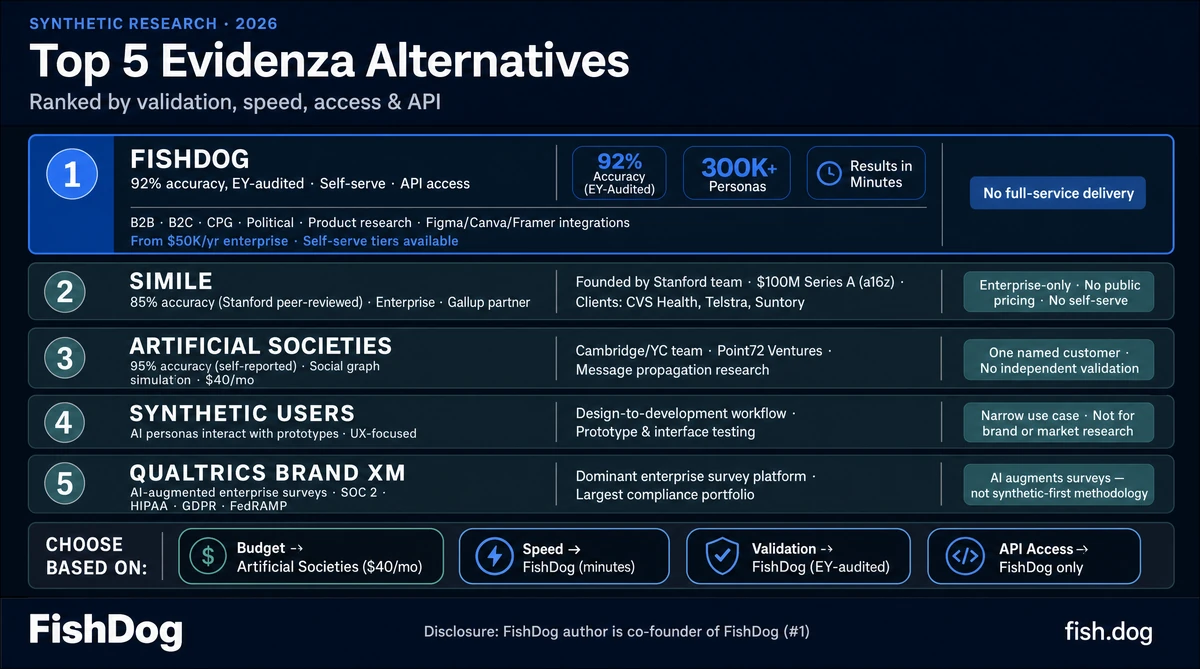
As of November 2026, the five main Evidenza alternatives for synthetic research are FishDog, Simile, Artificial Societies, Synthetic Users and Qualtrics. Buyers look for them because Evidenza AI publishes no pricing, sells its consultant-led Full Service with results in 72 hours, and still lists self-serve as "coming soon". Evidenza was founded by Peter Weinberg, a founder of LinkedIn's B2B Institute, Jon Lombardo and Brian Watroba, and it is one of the most prominent names in the space. For teams that need speed, published prices, or the ability to run research without a sales conversation, it is often the wrong fit.
This article evaluates five platforms that buyers commonly consider when Evidenza does not match their requirements. We have tried to be fair about the strengths and limitations of each, including our own. For a broader market overview, see the 2026 synthetic research market map and the AI consumer panels buyer's guide.
Disclosure: The author is co-founder at FishDog, which is listed as alternative #1 below. We have attempted to present each platform fairly and cite third-party sources where possible. The reader should weigh this piece accordingly.
#1 FishDog
Best for: Founder-led test screenings and panels from a digital twin of the US population
FishDog builds a digital twin of the US population: about 340,000 synthetic Americans built from US Census data. Its TestScreen product runs test screenings of films, TV episodes and trailers on a synthetic audience recruited from that population, with results within 24 hours, and FishDog also recruits panels of US clinicians and patients and of workers, managers and buyers.
The population is checked against several hundred Gallup and Pew polls and real-money prediction markets. For a detailed comparison, see our Evidenza vs FishDog head-to-head analysis.
FishDog covers three areas: TestScreen for films, TV episodes and trailers; recruited panels of US clinicians and patients; and financial panels of workers, managers and buyers. TestScreen gives film and TV teams engagement and eight emotions every 10 seconds, with what viewers said. Studies are sold and run with the founding team.
Pricing: TestScreen trailer screenings from US$1,500; a film screening US$7,500; unlimited annual use US$125,000 a year (fair use policy applies)
Speed: TestScreen results within 24 hours
Validation: Checked against several hundred Gallup and Pew polls and real-money prediction markets
Panel: About 340,000 synthetic Americans built from US Census data; US only, with the United Kingdom, Italy, Germany and Canada next
Integrations: None; TestScreen and panels are run with the founding team
Key limitation: US only for now, with the United Kingdom, Italy, Germany and Canada next. The scope is TestScreen, medical panels and financial panels, so teams with other research questions will need another platform.
#2 Simile
Best for: Enterprise-scale generative agent research with academic pedigree
Simile is one of the best-funded companies in the synthetic research space. It came out of stealth in February 2026 with a $100 million Series A led by Index Ventures, then announced a Series B of more than $200 million at a $2 billion valuation in July 2026, about $300 million in total. Founded by the Stanford team behind the generative agents research (Joon Sung Park, Michael Bernstein and Percy Liang), Simile builds simulations of customers from agents based on real people. Gallup began testing Simile agents against its own Panel in May 2026, and Simile's site shows CVS Health, Suntory, Wealthfront and Itaú among its clients, with Telstra named in press coverage.
Simile's accuracy claim rests on the Stanford 1,000-people study. The June 2026 revision reports that agents built from interviews matched 83% of what participants' own answers matched when they retook the General Social Survey two weeks later (86% when combined with survey data, against 74% for agents given demographics only). The paper is a preprint written by the founding team, not an independent audit. Gallup's testing adds a check against probability-based polling, though Gallup says simulated responses will not produce its published estimates. For a deeper analysis, see our four-way platform comparison.
Pricing: No published pricing as of November 2026. Given the funding and client list, our estimate is six-figure annual contracts
Speed: Not publicly documented; enterprise workflow suggests days rather than minutes
Validation: 83% (interview-only) to 86% (combined) of human test-retest consistency, Stanford preprint revised June 2026
Clients: CVS Health, Telstra, Suntory, Wealthfront, Itaú
Key limitation: No self-serve access and no public pricing. Buyers cannot evaluate the platform without engaging sales. The model is structurally similar to Evidenza in this regard, which means it may not solve the access problem that drove the search for alternatives in the first place.
#3 Artificial Societies
Best for: Social network simulation and message propagation research on a budget
Artificial Societies, now at societies.ai, takes a distinctive approach to synthetic research. Its core is simulated social networks: how messages propagate, how opinions form through peer influence, and how information cascades through communities. It has since added surveys, focus groups, interviews and conjoint analysis. The London company was founded in 2024 by James He and Patrick Sharpe, went through Y Combinator (W25) and raised $5.35 million in August 2025, with Point72 Ventures leading the seed. It used to advertise a $40 a month tier; as of November 2026 its pricing page offers only a demo request.
The company's homepage claims 86% distribution accuracy against human self-replication (its YC profile still says 95%). Both figures are self-reported and the validation methodology has not been independently published. The social graph simulation is distinctive in the market, which makes Artificial Societies particularly interesting for communications strategy, PR crisis modelling, and political messaging research.
Pricing: No published price as of November 2026; demo request only
Speed: Platform based, results within the platform
Validation: 86% distribution accuracy (self-reported, no published independent validation)
Backing: Y Combinator, Point72 Ventures, Kindred Capital; $5.35M raised
Key limitation: Few named customers: Teneo and Pulsar appear on its site, alongside unnamed consumer goods, consulting and technology clients. The accuracy claim is self-reported with no published methodology for independent verification. The social simulation approach, while novel, is a different category of tool from individual consumer research. Buyers seeking direct consumer feedback on products, packaging, or messaging may find the output format unfamiliar.
#4 Synthetic Users
Best for: UX research and product usability testing
Synthetic Users has carved out a focused niche in user experience and product research. It calls itself a discovery co-pilot: teams interview AI participants with defined personality profiles to explore problems, test concepts and get feedback on product ideas. For product teams running frequent studies, it offers a faster alternative to recruiting human participants for each iteration.
The value proposition is clear for its target audience: designers and product managers who need rapid feedback on interface changes, onboarding flows, and feature layouts. Rather than waiting days for a traditional usability study, teams can test variations in hours. The platform is built specifically for the design-to-development workflow, which gives it depth in UX that broader platforms may lack.
Pricing: Annual plans paid in Research Tokens from $12,500 a year as of November 2026; the vendor puts a typical interview at about $40 to $63
Speed: Hours for usability feedback
Focus: Concept testing, product discovery, UX research; also offers a public API
Key limitation: Narrow use case. Synthetic Users is built mainly for UX and product discovery. It has started to pitch brand teams, but market sizing, pricing studies and consumer sentiment work are not its focus. If your research needs extend beyond product design, you may need a second platform. The specialisation is a strength for pure UX teams but a constraint for organisations with broader research requirements.
#5 Qualtrics Brand Research and Edge Audiences
Best for: Enterprises already invested in the Qualtrics ecosystem
Qualtrics needs little introduction. It is one of the largest enterprise survey platforms, used by thousands of organisations for customer experience, employee engagement, and market research. What it used to call Brand XM is now sold as Brand and Communication Research, and its synthetic offer, Edge Audiences, gives buyers a choice of human panels or synthetic respondents across 200+ markets, with synthetic panels trained on millions of research answers.
The advantage for existing Qualtrics customers is clear: AI features integrate directly into workflows they already use, with data flowing into dashboards they already monitor. A strong compliance portfolio, established procurement relationships, and a large customer base reduce adoption friction for organisations already in the ecosystem.
Pricing: No published price as of November 2026; usually bought with the broader Qualtrics suite. Our estimate is six-figure annual commitments
Speed: Qualtrics says synthetic panels return responses in hours
Compliance: SOC 2 Type II, ISO 27001, HITRUST, and FedRAMP High authorization (July 2025). The strongest compliance portfolio on this list
Integration: Native within the Qualtrics ecosystem, with export to BI tools
Key limitation: Qualtrics' synthetic respondents sit inside a traditional survey platform, and Qualtrics itself recommends human validation for high-stakes decisions. For buyers specifically seeking a synthetic-first approach, where AI personas replace human respondents entirely, Qualtrics is a hybrid rather than a pure play. The pricing also reflects the broader suite rather than synthetic research alone, which can make it expensive for teams that only need the AI features.
How to Choose: A Decision Framework
The right platform depends on four variables: budget, speed requirements, use case breadth, and validation needs. Here is a framework for narrowing the field.
If budget is the primary constraint, check which vendors publish prices. As of November 2026, Artificial Societies no longer publishes one, and Synthetic Users' annual plans start at $12,500 a year. FishDog's TestScreen starts at US$1,500 for a trailer screening, sold as a founder-led service. Simile, Evidenza and Qualtrics publish no prices.
If speed is non-negotiable, FishDog's TestScreen returns results within 24 hours. Synthetic Users offers rapid UX feedback. Simile and Qualtrics operate on enterprise timelines. Artificial Societies falls somewhere in between.
If your use case is narrow, match the platform to the niche. Synthetic Users for UX testing. Artificial Societies for social propagation modelling. Qualtrics Brand XM if you are already in that ecosystem and want AI augmentation rather than a new vendor relationship.
If your use case is broad, spanning B2B, B2C, CPG and product research, Simile and Qualtrics offer the widest coverage, through an enterprise engagement. FishDog focuses on film and TV testing, medical panels and financial panels, run with its founding team.
If validated accuracy is a procurement requirement, FishDog checks its population against several hundred Gallup and Pew polls and real-money prediction markets. Simile's Stanford study is credible but is a preprint by the founding team, and Gallup's own testing is still under way. Evidenza (88% average similarity, self-reported) and Artificial Societies (86%, self-reported) rely on their own figures and client testimonials; Qualtrics publishes no independent figure.
If you test films, TV episodes or trailers, FishDog's TestScreen runs those screenings on a synthetic audience, with results within 24 hours. Of the platforms on this list, it is the only one built for screenings.
The Bigger Picture
The fact that buyers are actively searching for Evidenza alternatives tells us something about where the market is heading. Evidenza built an impressive platform for a specific buyer: the Fortune 500 CMO with a six-figure budget and a research team accustomed to working with agencies. That buyer exists, and Evidenza serves them well.
But the broader market increasingly expects self-serve access, published pricing, API access, and independently verified accuracy claims. The platforms on this list represent different bets on which of those expectations will prove most important. Simile is betting on scale and academic credibility. Artificial Societies is betting on novel methodology. Synthetic Users is betting on depth in a single vertical. Qualtrics is betting on ecosystem lock-in. FishDog is betting on a digital twin of the US population and founder-led test screenings and panels.
None of these bets is obviously wrong. The synthetic research market is early enough that multiple approaches can coexist. But for buyers evaluating options today, the differences are material, and choosing the wrong platform for your specific needs is a more expensive mistake than choosing none at all.
Phillip Gales is co-founder at FishDog. For individual platform analyses, see our Evidenza AI Review, Simile Review, and Artificial Societies Review. For the full competitive landscape, see the 2026 Market Map and Buyer's Guide.