
Disclosure: FishDog is a synthetic-population platform and may compete with Aaru and several tools covered here in some buyer evaluations. The analysis below draws on public sources and separates documented fact from FishDog's interpretation.
As of November 2026, the main Aaru alternatives are FishDog, Simile, Synthetic Users, Evidenza and Qualtrics' synthetic audiences. Which one fits depends on whether you need a forecast or a synthetic population you can question. Aaru is the loudest name here: founded in March 2024 by Cameron Fink, Ned Koh and John Kessler, then aged 18, 19 and 15, and valued at a $1 billion headline figure. If you are searching for alternatives, the useful first question is not "who is cheaper." It is "do I need a prediction engine, or do I need a synthetic population I can question?"
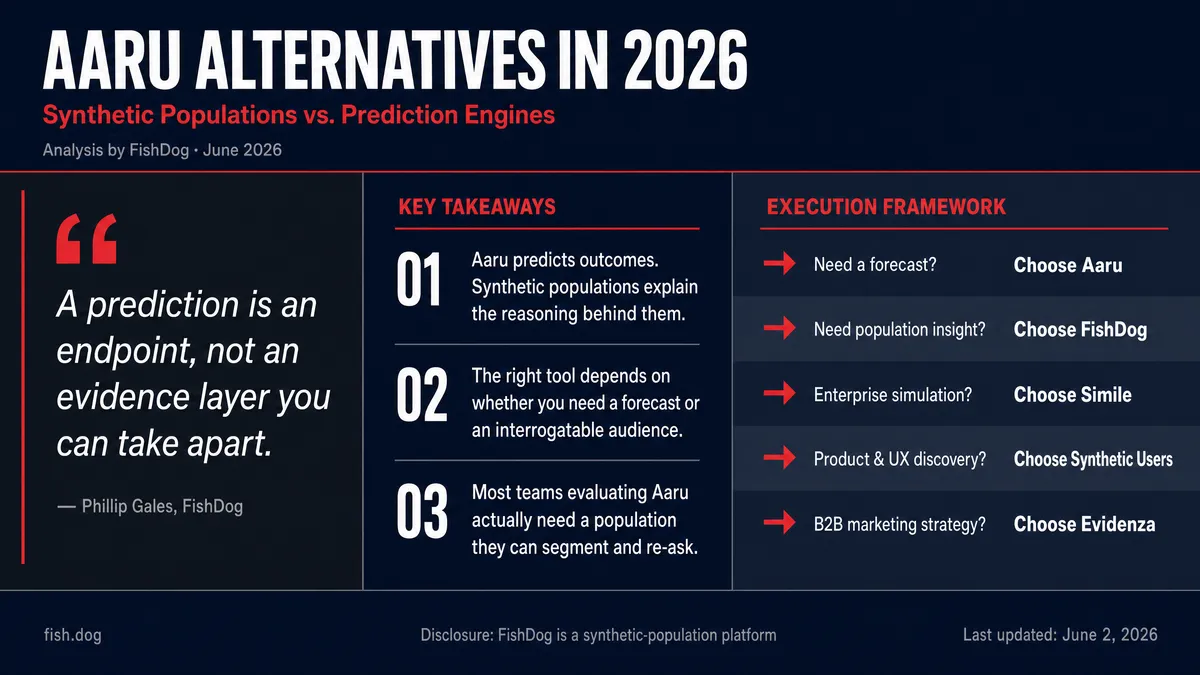
That distinction is the whole comparison. Aaru runs multi-agent simulations to forecast how people will respond: an election, a product launch, a consumer reaction. Many teams evaluating Aaru need something adjacent, a population-true synthetic audience they can interrogate, segment, and re-ask, where the answer is the reasoning, not just the result.
This guide compares the strongest alternatives by what you are trying to do.
What Aaru does, briefly
Aaru builds multi-agent simulations meant to predict human behaviour and outcomes. Its closing line is "See the future. Change the present." TechCrunch credits it with calling a 2024 New York Democratic primary, and its customers include Accenture, EY and Interpublic Group. In April 2026 Redpoint announced it is leading Aaru's $80 million Series A. Aaru publishes no prices. In our reading it is a predictive engine, not a survey tool and not a research platform you query for the why behind a number.
That is a useful capability. It is also a narrow one: a prediction is an endpoint, not an evidence layer you can take apart.
Quick recommendation
Choose Aaru if you need outcome prediction at scale and your decision is a forecast.
Choose FishDog if you need a population-true synthetic population you can question for film and TV testing, medical panels and financial panels.
Choose Simile if your need is enterprise behaviour simulation with academic lineage.
Choose Synthetic Users if your problem is product and UX discovery.
Choose Evidenza if your problem is specifically B2B marketing strategy.
Choose Qualtrics' synthetic audiences if you want synthetic capabilities inside an established enterprise research stack.
1. FishDog
FishDog builds a digital twin of the US population: about 340,000 synthetic Americans built from US Census data that you can question, segment, and re-ask. Where Aaru simulates agents to predict an outcome, FishDog gives you a population to interrogate: the reasoning, the objections, the distribution of views, not just a forecast.
That difference matters most outside the prediction use case. The same synthetic population can answer a film or TV audience question through TestScreen, a medical question put to recruited US clinicians and patients, and a financial question put to workers, managers and buyers, because the asset is the population, not a single model tuned to one outcome. Pick FishDog over Aaru when you need evidence you can take apart and reuse rather than a number to act on, and when you need to cover several decision types from one calibrated population, run with the founding team. Aaru is the better call when your decision really is a single high-stakes prediction and an outcome is all you need.
2. Simile
Simile comes out of the Stanford generative-agents research tradition and focuses on simulating customer behaviour with agents grounded in human data. It raised a $200 million-plus Series B at a $2 billion valuation in July 2026. Customers include CVS Health, Wealthfront and Itaú.
Best for:
enterprise behaviour simulation,
decision rehearsal,
teams that value academic pedigree and institutional partnerships.
Why choose it over Aaru:
you want behaviour simulation grounded in published generative-agent research,
you prefer an enterprise partner with a documented validation lineage (the Stanford "1,000 people" study, 2024, and the Gallup partnership).
When Aaru may be better:
your need is outcome prediction rather than behaviour modelling.
3. Synthetic Users
Synthetic Users focuses on product and UX discovery with AI-generated participants, and now also pitches research with buyers, doctors and voters. As of November 2026 it sells annual plans starting at $12,500.
Best for:
UX research,
prototype feedback,
early product discovery.
Why choose it over Aaru:
your question is about a product experience, not a market or political outcome,
you want early UX signal before recruiting real users.
When Aaru may be better:
you need population-level prediction, not product-level feedback.
4. Evidenza
Evidenza is built around B2B marketing and enterprise go-to-market research. Its full service delivers results in 72 hours; self-serve is still listed as coming soon. Evidenza reports an 88% average similarity with traditional research across 100+ of its own tests.
Best for:
B2B buyer research,
go-to-market and campaign planning,
full-service strategic research.
Why choose it over Aaru:
your audience is B2B buyers and your decision is marketing strategy,
you want marketing-science expertise packaged with the work.
When Aaru may be better:
the decision is a behavioural or market prediction rather than a go-to-market plan.
5. Qualtrics Edge Audiences
Qualtrics combines human panels in 200+ markets with synthetic audiences trained on millions of survey responses, inside the Qualtrics ecosystem. It launched these as Edge Audiences and publishes no price.
Best for:
enterprise research teams already on Qualtrics,
buyers who want human and synthetic options together.
Why choose it over Aaru:
your research operations already live in Qualtrics,
procurement wants a familiar enterprise vendor.
When Aaru may be better:
you specifically need agent-based outcome prediction outside a traditional research stack.
How to choose
Decide what the deliverable is:
If you need a predicted outcome, Aaru is on the shortlist.
If you need a population you can question across many decisions, consider FishDog.
If you need behaviour simulation with a research lineage, consider Simile.
If you need product or UX discovery, consider Synthetic Users.
If you need B2B marketing strategy, consider Evidenza.
If you need enterprise research infrastructure, consider Qualtrics.
Who this is not for
If your decision is a one-off forecast and you do not need to inspect the reasoning, a prediction engine like Aaru may be all you require, and a queryable population is overkill. Conversely, if you need regulatory-grade evidence or observed real-world behaviour, no synthetic approach (Aaru's or anyone else's) is the final layer; use it to decide what to validate with real people.
Bottom line
Aaru is a serious prediction company, but prediction is one job, not the whole category. For an outcome forecast, evaluate Aaru. For a synthetic population you can question for film and TV, medical and financial research, evaluate FishDog. For behaviour simulation, Simile; for UX, Synthetic Users; for B2B marketing, Evidenza; for enterprise infrastructure, Qualtrics.
The right alternative depends less on which company raised the most and more on whether you need a number to act on or a population you can take apart.
Related reading
Figures here come from public sources and were checked in November 2026. Funding, pricing, and product details move fast, so if we got something wrong, contact us and we'll fix it.