
Disclosure: FishDog is a synthetic-population platform and may compete with Aaru in some buyer evaluations. This review draws on public sources and separates documented fact from FishDog's interpretation.
Aaru is a New York AI company that builds populations of AI agents to predict how people will behave. As of November 2026 it sells to large enterprises with no published pricing, and its best-known proof points are an election call and an alliance with EY. Founded by teenagers in March 2024 and valued at a $1 billion headline figure less than two years later, it rests on a bold thesis: that you can simulate human behaviour well enough to predict outcomes before they happen.
The useful question for a buyer is narrower than the headlines. What does Aaru do, what evidence stands behind it, and when is a prediction engine the right tool versus a synthetic population you can question?
Quick verdict
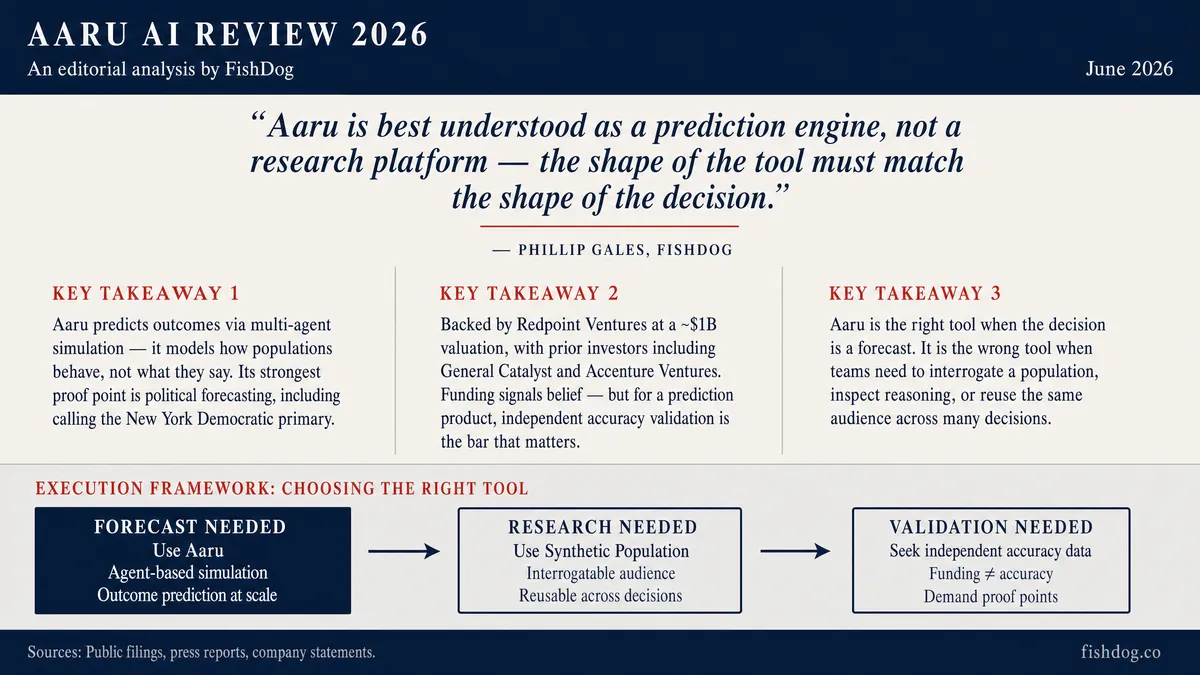
Aaru is best understood as an agent-based prediction and simulation company. Its strength is forecasting outcomes, from elections to how a target audience responds to a message, price or product, by simulating AI agents rather than asking people questions. For organizations whose decision is a forecast, and who can work through a high-end enterprise engagement, Aaru belongs on the shortlist. For teams that need to interrogate a population, inspect the reasoning, and reuse the same audience across many decisions, it is the wrong shape of tool.
What Aaru does
Aaru builds multi-agent simulations to predict human behaviour and outcomes. Its founders are Cameron Fink, Ned Koh (president) and John Kessler (CTO). Its About page lists use cases from product innovation and marketing to audience segmentation and scenario planning. The pitch is a prediction, not a survey you run or an evidence layer you take apart.
Aaru's polling reportedly predicted a 2024 New York Democratic primary, according to Semafor reporting cited by TechCrunch in December 2025. In a blinded test, Aaru reproduced EY US's 2025 Global Wealth Management study, six months of fieldwork with 3,600 investors across more than 30 markets, in a single day (EY, September 2026); lead investor Redpoint puts the match at 90% correlation with human responses. Named clients include EY, Accenture and Interpublic Group (now part of Omnicom), alongside political campaigns.
Funding and standing
Aaru's Series A was led by Redpoint Ventures. TechCrunch reported in December 2025 that the round was above $50 million and sold some equity at a $1 billion headline valuation, with lower-priced tiers bringing the blended valuation below that. In April 2026 Redpoint put the round at $80 million. Earlier pre-seed and seed capital came from investors including General Catalyst, Accenture Ventures, Felicis, and Abstract Ventures. In October 2026 it opened a Singapore office, its first base outside New York. The valuation and the founder story have drawn heavy press (WSJ, TechCrunch, CNBC), which is part of why buyers keep encountering the name.
Funding is a signal of belief, not of accuracy. For a product whose entire promise is prediction, the bar that matters is validation on your kind of outcome. The EY study is the most detailed public evidence so far, but EY is a commercial partner, and fully independent tests remain hard to find from the outside.
Where Aaru looks strong
Outcome prediction at scale. When the decision is a forecast, an agent-interaction model is a different approach from polling or surveys.
High-stakes, time-sensitive calls. Elections are unforgiving, fast-moving domains, and a system built for them is built for pressure.
Narrative and access. The valuation, the coverage and partners such as EY open doors, and for some buyers institutional confidence is part of the purchase.
Where buyers should be careful
A prediction is an endpoint, not evidence. You get an outcome, not the deliberation behind it. If your decision needs the why, the objections, the segments, the distribution of views, a forecast alone will not give it to you.
Validate for your domain. Calling an election or matching one wealth study does not automatically transfer to your category, your market, or your audience. Ask for accuracy evidence on the specific kind of outcome you care about.
Transparency and access. From the outside, methodology and study setup are hard to inspect, and as of November 2026 Aaru publishes no pricing. Expect a sales-led, enterprise engagement.
Aaru compared with FishDog
Aaru and FishDog are both synthetic-population approaches, and they do different jobs.
Aaru simulates agents to predict an outcome. FishDog builds a population-true synthetic population of the US you can question, for film and TV test screenings, clinician and patient panels, and questions to workers, managers and buyers, and inspect the reasoning behind every answer.
In plain terms:
choose Aaru when you need a forecast and an outcome is enough,
choose FishDog when you need a population you can interrogate, segment, and reuse across many decisions.
Questions to ask before buying Aaru
What validation exists for my exact outcome type, not just the headline election cases?
How is uncertainty in a prediction expressed and bounded?
Can I inspect the agent assumptions, or only the final forecast?
How are private data and proprietary scenarios handled?
What is the implementation timeline and commercial model?
What decisions should not be made with Aaru?
Bottom line
Aaru is a credible, well-funded company with a distinct thesis: simulate to predict. That is one valuable job, and where the decision is a forecast, Aaru is worth serious evaluation.
But most teams searching the synthetic-population space do not need a single number. They need a population they can question and reuse. For that, the better starting point is a platform built to be interrogated across research, finance, and media, with validation you can inspect for your own decisions.
Related reading:
Figures here come from public sources and were accurate to the best of our knowledge in November 2026. Funding, pricing, and product details move fast, so if we got something wrong, contact us and we'll fix it.