
The Question
Specialty coffee brands love telling you about the specific farm where your beans were grown. The altitude. The soil. The farmer's name. But do UK consumers actually care? I ran a study to find out.
So I ran a study. I recruited 10 UK consumers aged 25-55. A mix of daily coffee drinkers, occasional buyers, and budget-conscious shoppers from across England. 7 questions, no script, no leading. Just honest reactions.
The Participants
10 consumers aged 28-49 from Leeds, Armagh City, Banbrid, Liverpool, Bradford and beyond. A proper cross-section of everyday shoppers.
How do you currently discover new coffee brands? Through friends, shop...
This one got people talking.
Right, a couple of “try this” bags at £7 instead of my £5-6 baseline is £24-48 a year, so I don’t chase new brands for fun.
— Daniel Petersen
Mainly the supermarket aisle.
— Daniel Hargreaves
Short answer: I don’t go hunting for coffee brands.
— Daniel Hanna
Key insight: The consistency across responses is striking. This is not a fringe opinion.
If someone gifted you a coffee subscription, would you be pleased? Wha...
This one got people talking.
If it’s a proper gift with no strings, dead on.
— Ciaran O'Neill
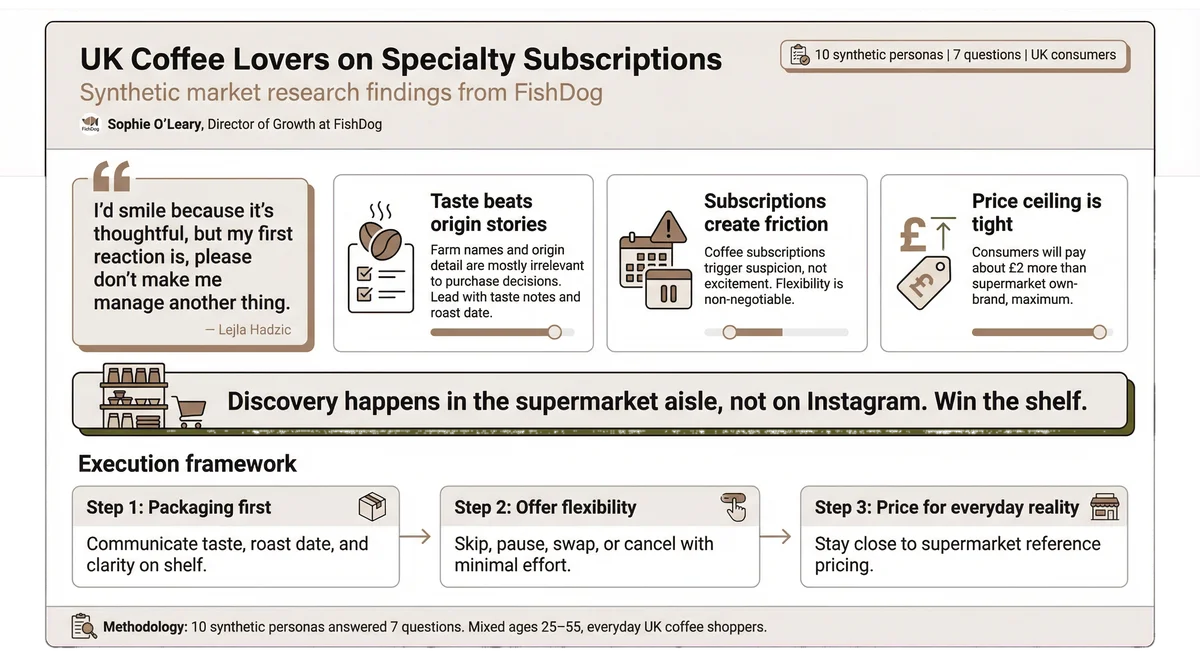
I’d smile because it’s thoughtful, but my first reaction is, please don’t make me manage another thing.
— Lejla Hadzic
Honest answer? I’d say thanks, then feel a tiny knot in my stomach.
— Daniel Hanna
Key insight: The consistency across responses is striking. This is not a fringe opinion.
When a coffee brand tells you about the specific farm where your beans...
This one got people talking.
Short answer: mostly irrelevant.
— Kelly Atkinson
Short answer: mostly irrelevant.
— Ciaran O'Neill
Gut reaction? I do a tiny eye-roll at the farm name thing.
— Emma Hargreaves
Key insight: The consistency across responses is striking. This is not a fringe opinion.
How much more would you pay per bag for speciality coffee versus super...
This one got people talking.
Gut feeling? I am not paying loads more, sorry.
— Emma Hargreaves
Day to day, £1-2 more max than supermarket own-brand.
— Daniel Hanna
Day to day, I’ll pay about £2 more than a decent supermarket bag, tops.
— Kelly Atkinson
Key insight: The consistency across responses is striking. This is not a fringe opinion.
What This Means for Brands
The findings paint a clear picture. Here is what brands in this category should take away:
Farm origin stories are mostly irrelevant to purchase decisions. Lead with taste and roast date.
Coffee subscriptions trigger suspicion, not excitement. Flexibility is non-negotiable.
The price ceiling is tight: consumers will pay about two pounds more than own-brand, maximum.
Discovery happens in the supermarket aisle, not on Instagram. Win the shelf.
The Bigger Picture
The specialty coffee market in the UK faces a trust gap. Consumers appreciate quality but they do not value the storytelling that brands invest so heavily in. The winners will be the ones that prove quality in the cup, keep subscriptions frictionless, and meet consumers where they actually shop.
Want to test your own positioning? FishDog lets you run studies like this in minutes. Book a demo at fish.dog.
What the Research Revealed
We asked real consumers to share their thoughts. Here is what they told us:
How do you currently discover new coffee brands? Through friends, shops, social media, or something else? What makes you switch from your regular?
Daniel Petersen, 39, Vocational Training Student, Leeds, West Yorkshire, United Kingdom:
Right, a couple of “try this” bags at £7 instead of my £5-6 baseline is £24-48 a year, so I don’t chase new brands for fun. I switch only when there’s a clear win I can taste or a price that lands near my normal. How I actually find new stuff: Supermarket aisle: yellow-sticker or clubcard deal on 500 g under £7 with a proper roast date. That’s 90% of it. Local stall at Kirkgate Market or the indie near town: free taster, straight answers about roast date and profile. If it’s good and not daft money, I’ll grab one. Mates: someone brings a bag to five-a-side or a neighbour brews a cup. If it’s clearly better in the moka-pot, I’ll note it. Reviews/threads: Which? roundups or a Reddit comment saying “X supermarket beans are decent now.” Ads and influencers get ignored. What makes me switch
Daniel Hargreaves, 48, Maintenance Technician, Leeds, West Yorkshire, United Kingdom:
Mainly the supermarket aisle. Tesco or ALDI end caps, yellow stickers, multi-buys. If my usual’s out of stock or there’s a cracking offer, I’ll try a new one. I don’t use social for coffee. Ads feel like fluff. Sometimes a mate at work rates a bag, or I have a good cup in a cafe and look for something similar, medium-dark and chocolatey. What makes me switch: Price per 100g drops or a big promo. My usual tastes off or they’ve changed it. Clear strength 4-5, whole beans, fresh roast date, resealable bag. A gifted bag or free sample. Ethical tag only if it’s the same money. Farm stories and fancy bags don’t move me. If it’s eight quid, jog on.
Daniel Hanna, 49, Healthcare Administrator, Bradford, West Yorkshire, United Kingdom:
Short answer: I don’t go hunting for coffee brands. If I find a new one, it’s by accident. Where I actually stumble on them: Supermarket shelf - yellow sticker, end-of-aisle, or my regular is out.Local cafe - I like the brew, see a bag by the till, check the price, maybe grab it if it’s sensible.Kirkgate Market - if someone’s grinding fresh and offers a quick taste, I’ll listen.Mates/Work - someone hands me a decent cup, I ask what it is, job done.Gifts - Christmas bag turns up, I’ll try it. If it’s faff or fancy, it sits in the cupboard. Social media? No. I don’t follow coffee people. Ads get swiped. If a WhatsApp link lands from a mate, I might look, but I’m not scanning QR codes for beans. What makes me switch: Taste on a try - if I drink it and it’s a steady medium roast, not burnt or
Ciaran O'Neill, 39, IT Support Specialist, Armagh City, Banbridge and Craigavon, Armagh City, Banbridge and Craigavon, United Kingdom:
Short answer: shops and mates, not social media. I’m in Tesco or Lidl anyway, so I spot a new bag on Clubcard and try it. If a mate brings a cracker to 5-a-side or a neighbour hands me a local bag, I’ll give it a go. Instagram ads and influencer waffle do nothing. I’ll clock a stall at St George’s Market or a wee cafe board now and then, but only if the price is sane and the roast date’s fresh. How I actually find new stuff: Supermarket aisles - end caps, Clubcard yellows, Lidl specials Word of mouth - a mate with decent taste, not a coffee snob Local stalls - market or farm shop if it’s sharp-priced and 250g proper Gifts - Christmas or birthdays, I’ll test it and keep the best Cafe tasters - only if I can buy the same bag without paying tourist tax What makes me switch from my regular:
Jamie Collins, 28, Registered Nurse, Bristol, City of, Bristol, City of, United Kingdom:
Short answer: shops and baristas first, a bit of Instagram, and sometimes Reddit. I don’t chase hype. How I find new stuff: Indie cafes/roasters: I try a cup, ask the barista what’s on, check the roast date. If it’s good, I’ll grab a bag. Markets and local shops: I cycle past anyway, so I scan the shelf for fresh roast dates and sane prices. Instagram: I follow a few local spots. If they post a new release with actual details, I’ll pop in. If it’s just vibes, I scroll on. Reddit: Very occasional r/bristol threads. Word of mouth from mates now and then. Supermarket: If a new bag lands with a decent date and a promo, I’ll test it. What makes me switch: Taste first: usually clean, chocolatey or nutty. If I try it by the cup and it bangs, I’ll buy. Price: under my usual ceiling. If it cre
Declan Murphy, 48, Unemployed Adult, Liverpool, Merseyside, United Kingdom:
Short answer: I don’t really hunt for new coffee. I grab my Aldi bag and crack on. If something new lands in my lap, fine, but I’m not trawling Instagram for beans. Feels like adverts with extra froth. I stumble on new stuff through: Shops - end-of-aisle or a yellow sticker. If it’s cheap and 250g, I’ll try it. Mates - someone brews a decent mug at five-a-side or the community centre and slips me a scoop. Gifts - helped a mate move and he chucked me a fancy bag as a thank you. I drank it, said cheers, went back to Aldi. Local stalls - once in a blue moon at a market if they’re pouring free tasters and not talking nonsense. Facebook - local group posts a genuine deal. Not influencer waffle. Little treat - won a few quid on a scratchie, might grab a posh bag for a weekend with Callum, then
Leanne Cartwright, 35, Logistics Coordinator, Birmingham, West Midlands, United Kingdom:
Mostly I stumble on new coffee by accident. If I’m in Aldi or Sainsbury’s and there’s a promo end cap or yellow sticker, I’ll grab a bag. If a mate raves about one, I’ll nick a scoop to try first. I’ll clock the bag at an indie in Kings Heath or Moseley if the cup tastes clean, but I rarely buy beans there because price. Farmers market stalls sometimes catch me, but only if I can taste before I pay. Insta ads get a hard scroll unless it’s dead clear and not waffly. What actually makes me switch: Price first - same price as my usual or £1-2 more tops. Taste proof - I’ve sipped it in a cafe or a mate’s, or I can try a small taster bag. No faff online - clear roast date, letterbox-friendly, cheap postage, no forced sub. Simple info - medium roast, ground for cafetiere, none of the poetry. R
Emma Hargreaves, 45, Volunteer Coordinator, Barnet (London Borough), Greater London, United Kingdom:
Honestly, I do not go hunting for coffee brands. I bump into them in the shops - a Clubcard price end-of-aisle, a Lidl special, or a bag by the till at a cafe after a matinee at the Phoenix. Sometimes a friend brings one to book club and I’ll nick a scoop to try, or I spot something at the church raffle hamper and think, fine, why not. Social media? No, not really - I scroll Instagram for dogs and quilts, not beans, and influencer chat makes me do a tiny eye-roll. What makes me switch is very plain: it is on offer, it works for our cafetiere, and it actually tastes nicer than our usual without creeping past about seven quid. If my regular is out of stock, I’ll grab whatever decent-looking one is cheaper that week and see if it’s smoother and not bitter. Decaf option helps, silly tasting n
Lejla Hadzic, 28, Administrative Assistant, Liverpool, Merseyside, United Kingdom:
Short answer: shops and cafes, not Instagram. I bump into new coffee when I see it on a shelf or taste it in a flat white that’s actually good. Friends sometimes, ads almost never. How I find new stuff now: Supermarket shelf scan - I check roast dates and price per 100g. If it’s fresh and in my £8-10 for 250g zone, I’ll try it. Local cafes/roasters - If a cup is clean and not sour, I ask what it is and grab a bag at the counter. Markets and little stalls - If I’m already there with Amir and it smells right, I’ll pick one up. Travel pickups - On a UK weekend, I’ll bring back a bag if the date is recent. Cute story is nice, but I buy on freshness. People I actually trust - a colleague or the mums’ WhatsApp group, but only if they mention freshness and a sane price, not “you must try this,
Kelly Atkinson, 47, Customer Success Manager, Bradford, West Yorkshire, United Kingdom:
Short answer: not social, not influencers. I find new coffee by accident when I’m already out and about, or someone sticks a bag in my hand. How I actually discover it End-of-aisle deals at Aldi or ASDA. I see it, I grab one. Local stalls - Saltaire market or a pop-up in town. Quick taste, no faff. A cafe brew I like, I ask what it is. Simple. Gifts or work hampers at Christmas. If it’s decent, I’ll note it. Mates bringing a bag to mine. We try it with a brew and decide fast. City breaks - I’ll pick a bag from a roaster in York or Manchester as a treat. What makes me switch from my regular Taste beats my usual in a cafetiere. Not sour, not weak. Price is right - under my cut-off, or a proper promo. No silly postage. Easy to get again - in my normal shop or dead simple online. Clear in
If someone gifted you a coffee subscription, would you be pleased? What would make it a good gift versus an unwanted commitment?
Ciaran O'Neill, 39, IT Support Specialist, Armagh City, Banbridge and Craigavon, Armagh City, Banbridge and Craigavon, United Kingdom:
Short answer: maybe. If it’s a proper gift with no strings, dead on. If it smells like a sneaky sign-up, hard no. It’s coffee, not a gym membership. What makes it a good gift: Prepaid, fixed term - 2 or 3 bags, or 3 months tops. No auto-renew. No card needed to redeem. My choice - medium roast, not sour, works in a wee cafetiere. Ability to pick grind or whole bean, and swap out weird experimental stuff. Timing control - I redeem when I want, can skip a month. No bags piling up when we’re away. Clear specs - roast date on bag, proper 250g not a cheeky 200g, simple flavour notes that actually show up. NI-friendly - letterbox delivery, no “UK mainland only” nonsense or extra postage to Lurgan. What makes it an unwanted commitment: Auto-renew, free trial that grabs my card, or cancellation
Lejla Hadzic, 28, Administrative Assistant, Liverpool, Merseyside, United Kingdom:
Short answer: mixed. I’d smile because it’s thoughtful, but my first reaction is, please don’t make me manage another thing. Subscriptions feel like admin - surprise charges in my Monzo and boxes landing mid school run. What makes it a good gift for me: Fixed term - 1 to 3 deliveries, no auto-renew, and no card required to activate My timing - redeem when I actually need beans, easy pause for Ramadan or a Sarajevo trip Letterbox-friendly with fresh roast dates - no courier dance Choice - decaf option, whole bean vs grind, and a sane roast style Simple redemption - a code, 3 clicks, done; no 20-question quiz Transparent size and packaging - real 250g, recyclable bag, no tiny 200g pretending What makes it an unwanted commitment: Auto-renew or “enter your card to claim” tricks Rigid monthly
Daniel Hanna, 49, Healthcare Administrator, Bradford, West Yorkshire, United Kingdom:
Honest answer? I’d say thanks, then feel a tiny knot in my stomach. I mostly drink tea. I don’t want bags piling up while the jar is still half full. So I’d be pleased if it’s tight, finite, and on my clock. If it turns into admin, it’s a no. What makes it a good gift: Fixed length - like 2 or 3 bags, then done. No auto-renew.Redeem when I want - vouchers or codes, not set dates.My pick - grind size, a steady medium roast, decaf option.Easy skip/cancel - one click, no chat, no grief.Letterbox friendly with clear roast dates and a seal that actually seals.No hard sell - no weekly emails nagging me to add extras.Price sensible - not over £6 a 250g bag.Nice-to-have: local roaster, and if they talk ethics, show receipts. What makes it an unwanted commitment: Auto-renew or rolling plan I have
Jamie Collins, 28, Registered Nurse, Bristol, City of, Bristol, City of, United Kingdom:
Short answer: sort of. I’d smile, say cheers, but I’d be wary it’ll turn into homework or clutter in my tiny flat. It’s a good gift if it’s truly pre-paid and no-strings: I don’t enter a card, there’s no auto-renew, no sneaky upsell later I trigger each delivery when I’m actually low, so bags don’t pile up I can choose the bag each time and check roast dates Price lands under my usual ceiling, with shipping covered Ideally a solid indie roaster with real detail on the coffee, and packaging I can recycle Bonus if I can swap it for a simple voucher instead It’s an unwanted commitment if: It auto-rolls onto my card or wants me to add payment to “activate” it Fixed monthly drops I can’t pause or skip Mystery-only bags I wouldn’t pick, and no way to switch Too much coffee turning up at once
Daniel Petersen, 39, Vocational Training Student, Leeds, West Yorkshire, United Kingdom:
Right, I’d smile, say cheers, then I’d check the small print. If it looks like work or costs silly money, it’s a no in my head. I get through about 500 g a month, moka-pot, medium roast. Anything that dumps random £9 250 g bags on me every fortnight is just clutter. What makes it a good gift: Prepaid, no auto-renew. No card needed to redeem, no “intro price then hike”. One 500 g per month, or bankable credit so I order when the jar’s low. My pick each time - medium roast, moka-friendly, not sour. Whole beans, clear roast date. Simple controls: skip or pause with one click, set delivery week, letterbox-friendly. Not daft pricing: not sending £10 per 250 g to my house. What makes it an unwanted commitment: Auto-renew or asking for my card to activate. “Surprise” light roasts, funky ferm
Daniel Hargreaves, 48, Maintenance Technician, Leeds, West Yorkshire, United Kingdom:
Gut feel? I’d say cheers, then I’d eye it for the catch. Subs feel like homework. If it bills me after month three, I’m grumpy. I don’t want another thing to manage in the week. Good gift if: Fixed length - 3 months then it stops. No card. No auto-renew. Sensible pace - one 250g bag a month or 6 weeks. Letterbox friendly. Easy to skip by text or a simple link. My taste - whole beans, medium-dark, strong, chocolatey. Not sour, not fancy fruit salad. Clear info - roast date, strength number, resealable bag. Choice - pick from 2-3 styles or do a one-off taster box. Unwanted if: I must enter my card to activate or it auto-renews. Too frequent or big bags so it piles up in the cupboard. Faffy app, logins, spammy emails. All light roasts that taste like lemon. No thanks. Needs a signature o
Kelly Atkinson, 47, Customer Success Manager, Bradford, West Yorkshire, United Kingdom:
Honestly, I’d smile and say ta, but I’d be wary. I don’t like being tied in. If it’s dead simple and on my terms, I’d enjoy it. If it’s faffy or starts stacking bags, hard no. Good gift Prepaid, fixed length. 2-3 months tops. No auto-renew. One bag a month, 225-250g. Not tiny tasters. Let me start when I want. Simple code, no clock ticking. Pick beans or ground. I want ground for my cafetiere. Normal roasts that brew well. Not sour fruit bombs. Clear roast date and delivery. No waffle. All-in price with postage. No extras at checkout. Skip or swap easily. One click, no emails. Unwanted commitment Auto-renew or card on file. Weekly drops. Bags piling up. 100g samples at silly prices. Hypey farm poems instead of straight info. Needs a grinder or fancy kit. Fussy cancel steps or hidden f
Emma Hargreaves, 45, Volunteer Coordinator, Barnet (London Borough), Greater London, United Kingdom:
Honestly, I’d smile because it’s thoughtful, then do a tiny gulp about it turning into admin. I like coffee, but I cannot be doing with another login, reminders, and bags piling up when we are swimming in Tesco bits already. It would be a good gift if it is pre-paid, finite, and no auto-renew, with me choosing timing, size, and cafetiere grind - and the option to switch to decaf if we fancy a calmer week. Let me start when we actually need it, pause without faff, and pick something normal without flowery tasting notes that make me feel like I should write a review. It turns into an unwanted commitment the minute they want my card to “activate,” try to upsell, or send too much coffee on a rigid schedule - or if it’s whole beans when we do not own a grinder. If I’m honest, a simple voucher t
Declan Murphy, 48, Unemployed Adult, Liverpool, Merseyside, United Kingdom:
Gut reaction? Mixed. I’d say cheers and try it, but if it smells like homework or a sneaky tie-in, I’m out. I don’t want another account to manage or beans piling up when I’m on tea that week. Make it feel like a treat I control, not a chore I babysit. It’s a good gift if: Prepaid for a set number of bags, no auto-renew, no card needed from meRedeem when I want, easy pause, one bag at a time so the cupboard’s not rammedChoose ground for cafetiere, clear roast date, 250g minimum, no titchy 200gNormal flavours that brew strong and clean, not sour fruit bombsNo postage added at checkout, and a local pickup option is a bonusPlain-English info, maybe a refill tin or a mug so it’s practicalDecaf swap for evenings so I’m not wired when Callum’s here It’s an unwanted commitment if: They want my
Leanne Cartwright, 35, Logistics Coordinator, Birmingham, West Midlands, United Kingdom:
Gut reaction? Mixed. I’d say thanks, but I’d also side-eye it in case it’s a faff or a trap. My coffee use swings and I hate feeling tied to anything. If it starts nudging me for my card or piling up bags while I’m on a tea week or away in Worcester, I’m annoyed. What makes it a good gift: Prepaid and short - like 2-3 bags, clear end date, no auto-renew. No card needed from me. A simple code, job done. Real control - I pick delivery weeks, easy pause or skip, text before it ships. My setup - ground for cafetiere, medium roast, roast date shown. Letterbox friendly so I’m not racing the postie. Plain English, not waffly tasting notes or guilt-trippy “ethical” fluff. What makes it an unwanted commitment: Needs me to sign up with my card or bury the cancel button. Auto-renews or nags me t
When a coffee brand tells you about the specific farm where your beans were grown, does that feel authentic and worth paying for, or is it irrelevant to you?
Kelly Atkinson, 47, Customer Success Manager, Bradford, West Yorkshire, United Kingdom:
Short answer: mostly irrelevant. Naming a farm on its own means nowt to me. It often feels like a story to bump the price. If they show the farm, what they actually paid, roast date, and it tastes better in my mug, fine - but I’m not paying extra for a paragraph on the bag. It’s a tie-breaker only if taste and price are neck and neck. Otherwise, that’ll not wash.
Ciaran O'Neill, 39, IT Support Specialist, Armagh City, Banbridge and Craigavon, Armagh City, Banbridge and Craigavon, United Kingdom:
Short answer: mostly irrelevant. A farm name on a bag is a nice postcard, but I’m not paying extra for a story. Tell me what it tastes like and when it was roasted, then we’re talking. It feels authentic only if it ties to the cup and the price: Specifics that predict taste - process, variety, roast date, and clean flavour notes that actually show up in the mugNumbers - what they paid vs market, not fluffy copyConsistency - same farm year to year and it tastes the same kind of good each time If it hits those and the price is close to my usual shop, grand, I might stretch a wee bit. But a named farm on its own is just marketing, and I’m not funding artisan tax. I’ll still pick the fresh medium roast on offer in Tesco or Lidl, check the unit price, and move on.
Emma Hargreaves, 45, Volunteer Coordinator, Barnet (London Borough), Greater London, United Kingdom:
Gut reaction? I do a tiny eye-roll at the farm name thing. It can feel quite authentic if they show something real - who they are, maybe what they were paid - but on its own it is just a nice label to read while the kettle boils. I like the story, I just am not paying extra for the story. If two bags taste the same and cost the same, I might pick the one that names the farm because it feels a bit more human. But if it means nudging past my budget, it is a no from me. Taste first, price right behind it - the farm detail is a pleasant extra, not a reason to spend more.
Jamie Collins, 28, Registered Nurse, Bristol, City of, Bristol, City of, United Kingdom:
Short answer: no - the farm name can feel more authentic, but I’m not paying extra just for that. If they name the farm and also show what they paid, harvest year, roast date, and that it’s a long-term thing, I trust it more. If it’s just a postcard vibe, I ignore it. It only changes my choice if two bags tie on taste and price. Then the specific farm can tip it. But taste still wins. If the farm-named bag tastes better and sits under my usual ceiling, great. If it’s £13+ purely because they wrote the farm on the label, it’s a no from me.
Declan Murphy, 48, Unemployed Adult, Liverpool, Merseyside, United Kingdom:
Gut check? Irrelevant nine times out of ten. Nice bit of poetry about a hillside farm, but I’m just trying to get a strong mug in before the school run without rinsing my budget. If it tastes proper and the price is sound, fine. I’m not paying extra for a postcard on the bag. It can feel authentic if they keep it real and don’t bump the price: Plain farm name, roast date, and how it’ll brew in a cafetiere, no wafflePrice within a quid of supermarket, no sneaky postage or titchy 200g bagsLocal refill or a small discount so it’s practical, not preachy But worth paying for? No. Tell me the farm if you want, but if it’s a fiver more, jog on. I’ll grab my Aldi bag and get on with my day.
Daniel Hanna, 49, Healthcare Administrator, Bradford, West Yorkshire, United Kingdom:
Short answer: mostly irrelevant on its own. A farm name feels authentic only if they show the guts of it. If they share who they bought from, what they paid, when they went out, and who checks it, then I believe it. Otherwise it is a postcard on a bag. Will I pay more for that story? No. If two bags are neck and neck on taste and price, it might tip me, but I am not adding coins just for a label. I mostly drink tea, so coffee has to earn its keep. Give me flavour, fair price, and something I can grab at Asda - the farm bit is a nice extra, not a reason to pay more.
Lejla Hadzic, 28, Administrative Assistant, Liverpool, Merseyside, United Kingdom:
Short answer: Mostly irrelevant on its own. A farm name sounds more authentic than generic “ethical” copy, but it doesn’t make me pay extra by itself. Maybe I’m a bit cynical, but I’ve read too many bags telling me a sweet story while the coffee tastes flat. What makes it worth something: Farm + lot specifics - region, harvest year, process, varietal, and a clear roast date Price transparency - how much they paid vs market or certification, not just “we pay more” Consistency proof - multi-year relationship or any independent check Taste first - clean, fresh, matches the notes without me fighting it at the grinder What is noise: Postcard paragraphs, stock photos, “smallholder community” with no numbers A farm name slapped on stale beans or tiny 200g bags priced like 250g Price-wise:
Daniel Hargreaves, 48, Maintenance Technician, Leeds, West Yorkshire, United Kingdom:
Mostly irrelevant for me. Feels like a story to stick a quid on the price. Nice farm name, pretty bag, but I can’t check any of it stood in Tesco, so it’s just words. If it tastes better and it’s the same money, fair enough. I’m not paying extra for a postcard. Give me roast date, strength, and price per 100g. The rest can jog on.
Daniel Petersen, 39, Vocational Training Student, Leeds, West Yorkshire, United Kingdom:
Right, a farm name on a bag by itself is not worth a premium. If that’s £2 extra on my 500 g, that’s £24 a year for a line of text. No. It only feels authentic if it comes with hard info I can check. Otherwise it’s postcard fluff. Useful: farm or co-op name plus harvest year, lot, what they actually paid vs local price, and a clear roast date. Maybe worth £1 if I can taste a cleaner, more balanced cup in the moka-pot. If I can’t taste it, I won’t pay it. Irrelevant: leafy logos, long origin stories, no numbers. That’s marketing. Price and taste first. Trace is a nice extra, not a reason to spend more when I’m juggling school shoes and the mortgage.
Leanne Cartwright, 35, Logistics Coordinator, Birmingham, West Midlands, United Kingdom:
Honestly? Mostly irrelevant on its own. A farm name doesn’t make my cafetiere taste better, and I’m not paying extra just because they’ve slapped “Finca Whatever” on the bag. If it’s the same price as my usual and drinks nicer, fine, I’ll pick it. But I’m not stretching my food pot for a postcard. It feels authentic only if there’s stuff I can actually check: Specifics I can verify - farm name, harvest year, what they paid. Consistency - same taste week to week, not a one-off that vanishes. Plain English - no sunset photos and waffle. Roast date clearly shown. Pay more for it? No, not for the name alone. I’d do £1-2 more tops if it’s clearly better in the cup and the proof is easy to see. Otherwise it smells like a stunt, and I’ll just grab Aldi and get on with my day.
How much more would you pay per bag for speciality coffee versus supermarket own-brand? Is there a price where you say no regardless of quality?
Emma Hargreaves, 45, Volunteer Coordinator, Barnet (London Borough), Greater London, United Kingdom:
Gut feeling? I am not paying loads more, sorry. Our usual is the supermarket own-brand around £3-4, and I will go about £2 extra if it genuinely tastes better - maybe £3 on a treat week if I am feeling soft. Once it creeps past £8 for a 225-250g bag, it is a no from me, however poetic the tasting notes are. I did try one at roughly £9 and it was lovely for a Sunday cafetiere, then gone in days and I felt a bit daft. So yes, there is a hard line - around eight quid - and anything flirting with a tenner gets ignored, quality or not. I might be wrong, but I would rather spend the extra on a matinee ticket and stick the coffee on the Tesco order.
Daniel Hanna, 49, Healthcare Administrator, Bradford, West Yorkshire, United Kingdom:
Day to day, £1-2 more max than supermarket own-brand. If own-brand is about four quid for 250g, I’ll go to £5-6 if it tastes steady and is fresh. For a rare treat I might stretch to £7, but that is my hard stop. Anything £8+ for a 250g bag is a no, no matter how shiny the story is. And if the bag is a dinky 200g, that ceiling drops again. I am not paying silly money for a halo. Taste first, price close behind, then I walk.
Kelly Atkinson, 47, Customer Success Manager, Bradford, West Yorkshire, United Kingdom:
Day to day, I’ll pay about £2 more than a decent supermarket bag, tops. As a treat, I might stretch to £3-4 more if it’s clearly better in the cup. My cut-off is around £8-9 for 225-250g. Over £10 a bag it’s a no, no matter the tasting notes. If the bag’s smaller or there’s postage on top, I’m out even quicker.
Declan Murphy, 48, Unemployed Adult, Liverpool, Merseyside, United Kingdom:
Short answer: about a quid more, tops. Any more and I feel mugged before I have had a sip. My usual is Aldi/Lidl around three quid for 225-250g. I might stretch to £3.50-£4 if it’s fresh, strong, and suits my cafetiere. After that, nah. Hard no: anything starting with a 6. Tenner a bag for 250g? Behave. Bag size tricks: if it’s 200g trying to pass as 250g, instant no, even at £4. Only exceptions: yellow-sticker bargain, local roaster with a refill discount, or someone else bought it as a treat. Bottom line: if it strays much past supermarket price by more than a quid, jog on, no matter how lovely the origin postcard sounds.
Leanne Cartwright, 35, Logistics Coordinator, Birmingham, West Midlands, United Kingdom:
Short answer: £1-2 more, tops. Taste first, but my food pot is not a magic money tree. My lines in the sand: Day to day: £3-4 for a 200-250g supermarket bag. Speciality sweet spot: £5-6 if it’s clearly nicer in my cafetiere. Treat ceiling: £7-8 now and then, payday vibes only. Hard no: £9-10+ a bag, or silly small packs like 200g priced like gold. Add postage on top and it’s a flat no. If bills spike, I drop straight back to Aldi. I won’t pay extra for tasting-note poetry or a fancy valve on the bag. If two are the same price, fine, I’ll pick the one with real ethics I can check - but I’m not coughing up a tenner for beans, however lovely the chat.
Ciaran O'Neill, 39, IT Support Specialist, Armagh City, Banbridge and Craigavon, Armagh City, Banbridge and Craigavon, United Kingdom:
Short answer: not much. I’ll pay a wee bit more if it’s clearly better in the cup, but I’m not funding someone’s fancy label. Here’s my line: Day to day - I’ll go £1-2 more than supermarket own-brand, max. If own-brand is £3.50 for ~225-250g, I’ll stretch to £5-6 for proper fresh roast and cleaner taste.Occasional treat - maybe £7 for 250g if it’s cracking and local. That’s rare.Hard no - £8+ for 250g is a skip regardless of quality. And any 200g bag priced like 250g can get in the bin. I check the unit price. Look, if you want double the money, it needs to demolish the own-brand in taste and freshness and still land near six quid. Otherwise it’s artisan tax and I’m out.
Lejla Hadzic, 28, Administrative Assistant, Liverpool, Merseyside, United Kingdom:
Short answer: I won’t pay silly money for beans. Taste matters, but I have a budget and a child. If the price feels like boutique tax, I walk away. My rough lines in the sand: Supermarket baseline: around £3.50-4.50 for a 225-250g bag. Speciality sweet spot: £8-10 for 250g if roast date is recent and it actually tastes clean and bright. That’s about £3-4 per 100g. Stretch: up to £12 for something I know is great or a local roaster I trust. Hard no: £13-14+ for 250g is a automatic pass, no matter the story or tasting notes. Also a no to tiny 200g bags priced like 250g. Don’t play games. So yes, I’ll pay roughly double over own-brand if it earns it. Beyond that, I close the tab and buy fresh, sensible-priced beans instead.
Daniel Hargreaves, 48, Maintenance Technician, Leeds, West Yorkshire, United Kingdom:
Not much. If own-brand is a fiver, I’ll go 50p to a quid more if it’s a clear step up in taste. Hard stop for me is about £7 for a 200-250g bag - past that, no, even if it’s meant to be amazing. Day to day I stick to shop deals; fancy bags at eight quid can jog on.
Jamie Collins, 28, Registered Nurse, Bristol, City of, Bristol, City of, United Kingdom:
Short answer: not much more. - Day to day I’ll pay about £3-5 more than supermarket own-brand for a proper fresh bag from a local roaster. - My soft ceiling is ~£10-11 for 250g. If it’s stellar and it’s payday, I might stretch to £12. - Anything £13-14+ for 250g is basically a no for me, and £15+ is a hard nope regardless of how flowery the notes or how glossy the story is. I’m not funding a postcard and a fancy label. I’m on a budget, I buy as I need, and I can cycle to a shop. If the price climbs past that, I just grab the decent supermarket bag and get on with my morning.
Daniel Petersen, 39, Vocational Training Student, Leeds, West Yorkshire, United Kingdom:
Right, my baseline is £5-6 for 500 g. I’ll stretch £1-2 more if it’s fresher and I can taste it in the moka-pot. Past £7 it needs to be special. At £8 for 500 g it’s a hard no regardless of quality. Most 250 g “speciality” at £8-10 is an automatic no - that’s £16-20 per 500 g, which is £120-180 extra a year for me. Not paying triple for nice adjectives. 500 g: buy zone £5-7, absolute ceiling £8. 250 g: only if it’s ≤£4. Anything £5+ is a pass. If I fancy a treat, I might do £7-7.50 once in a while. As a routine, no.
What matters most to you when choosing coffee: taste, price, origin story, ethical credentials, or convenience?
Daniel Hargreaves, 48, Maintenance Technician, Leeds, West Yorkshire, United Kingdom:
Order for me, simple as this: Taste first. Strong, clean, not burnt. If it’s weak or sour, bin it. Price right behind. I check price per 100g and grab what’s on offer. A fiver-ish is my lane. Convenience. I want it in the weekly shop at Tesco/ALDI. No faff, no subs. Ethical stuff if it’s the same money. I’m not paying a halo tax. Origin story last. Nice postcard, nowt to do with my brew. If two bags taste the same and cost the same, I’ll take the ethical one. If not, jog on.
Declan Murphy, 48, Unemployed Adult, Liverpool, Merseyside, United Kingdom:
Cut to it: price wins, then taste. The rest is background noise unless it helps without a faff. Price - if it is not fair, I am not buying. I am not paying extra for a fancy label. Taste - strong, clean, not burnt. Works in my cafetiere and doesn’t go muddy. Convenience - grab a bag at Aldi when I am in. No subs, no forms, no waiting. Ethical creds - only if they prove it in plain English and don’t charge more. No leaf icons and sermons. Origin story - nice bedtime story for the packet, but I am not funding someone’s postcard. So yeah: price, taste, convenience. If the rest can keep up without bumping the bill, sound. If not, jog on.
Emma Hargreaves, 45, Volunteer Coordinator, Barnet (London Borough), Greater London, United Kingdom:
Gut feeling? Taste, or there is no point really. Then straight after that it is price, because we are counting pennies most weeks and I hate feeling ripped off for something that goes in a cafetiere and is gone in ten minutes. The origin story stuff makes me do a tiny eye-roll unless there is something real behind it, so probably not that, though if two bags taste the same and cost the same I will pick the one with a mark I recognise. Ethical bits are nice-to-have, not the decider. Convenience is fine, but we already chuck it on the Tesco order, so it is not winning any prizes. If I have to pick one, it is taste first, price snapping at its heels, and the rest trails behind.
Daniel Hanna, 49, Healthcare Administrator, Bradford, West Yorkshire, United Kingdom:
Taste first, price close behind, then convenience. The rest is garnish. I want a steady medium roast that is not burnt or sour. I am not paying silly money for a halo. If two bags are neck and neck, I will pick the one that actually shows receipts on ethics. Origin stories are nice, but they read like a leaflet. I mostly drink tea, so coffee has to be easy to grab in Asda, ground for the kit I have, and in a bag that seals. Order of play: TastePriceConvenienceEthical creds with proofOrigin story
Ciaran O'Neill, 39, IT Support Specialist, Armagh City, Banbridge and Craigavon, Armagh City, Banbridge and Craigavon, United Kingdom:
Taste first, price second. Everything else is noise unless it proves itself. Taste - if it’s clean, not sour, not burnt, and works in my wee cafetiere at home, I’m in. If it’s fancy but tastes like vinegar, straight in the bin.Price - I’m not paying artisan tax. I buy what’s on offer in Tesco or Lidl. If a local bag is close in price and nicer in the cup, grand.Convenience - I want to grab it with the weekly shop, check the roast date, and go. No waiting on couriers, no faff.Ethical creds - only matters if there are specifics and numbers. Otherwise it’s just sticker talk.Origin story - background fluff unless it predicts taste. Farm name and roast date help. Flowery copy does nothing. Right: give me a decent medium roast, fresh date, on Clubcard or a sharp Lidl price, and I’m happy. Ever
Kelly Atkinson, 47, Customer Success Manager, Bradford, West Yorkshire, United Kingdom:
Taste first, then price - simple as. If it’s not good in the mug, I don’t care about farm names or fluffy claims, and I’m not paying a fiver extra for a brown paper bag. Convenience counts because I buy as I need it, so Aldi most weeks and a local treat now and then; ethics and origin only nudge me if it’s clear and quick to check. If it’s waffle, that’ll not wash. Taste Price Convenience Ethical credentials Origin story
Daniel Petersen, 39, Vocational Training Student, Leeds, West Yorkshire, United Kingdom:
Right, my baseline is £5-6 for 500 g. If a bag creeps past £7, it has to earn it in the cup or it’s a no. I drink moka-pot, medium roast, nothing fancy. Order of what matters: Price: must sit near my baseline, within £1-2, or I walk. Taste: clean, balanced, not sour. If I can’t taste a clear step up, I won’t pay one. Convenience: buy when the jar’s low, at shops I already use. No subs, no faff. Ethical: only if they show actual numbers and trace. Small premium, fine. Vague badges, no. Origin story: nice paragraph, zero value. Not paying for copy. So it’s price first, then taste, then convenience. Ethics only if proven and cheap. The rest is fluff.
Leanne Cartwright, 35, Logistics Coordinator, Birmingham, West Midlands, United Kingdom:
Taste, every time. If it doesn’t make my cafetiere sing, I’m not paying extra for a nice story. Price is right behind it because my food pot isn’t magic, and I won’t spend a fiver more for vibes. Convenience matters when I’m low and busy, but I can always fall back on instant, so I won’t be held hostage by late deliveries or faffy subs. My order of importance: Taste - consistent, not burnt, works in my cafetiere. Price - decent value, no silly markup. Convenience - easy to grab when I need it, no traps. Ethical creds - only as a tiebreaker if there’s real proof. Origin story - nice to read, but it won’t sway me. If two bags are the same price, I’ll pick the one with clear, checkable ethics. If not, I’m going with the reliable supermarket one and getting on with my day. Keep the farm-poe
Lejla Hadzic, 28, Administrative Assistant, Liverpool, Merseyside, United Kingdom:
If I have to pick, it’s a clear priority order for me: Taste - plus freshness. If it doesn’t taste clean and recent roast date, nothing else matters. I won’t drink a flat, papery cup. Price - I have a Monzo pot and a child. I’ll pay a bit extra for good flavour, but not boutique-for-the-sake-of-it. Convenience - buy-when-I-need-it, fits around school run. I’m not chasing parcels or managing a fussy subscription. Ethical credentials - only if there are specifics and proof. Otherwise it’s background noise. With receipts, it becomes a tiebreaker and I’ll pay a little more. Origin story - I like a nice paragraph, but it’s decoration. Don’t make me decode fluff. So: taste first, then a sane price, then make it easy. Ethics count when they’re real. Stories are optional.
Jamie Collins, 28, Registered Nurse, Bristol, City of, Bristol, City of, United Kingdom:
Taste first, always. If it doesn’t taste good, what’s the point? Freshness and roast date sit inside that for me. Then price. I’m on a tight budget, so most weeks it’s decent supermarket beans, with the odd treat from a local roaster. After that, convenience. I buy as I need it, cycle to a shop, no subscription, no spare space for extra bags. Ethical credentials help only if there’s real proof and the price still makes sense. Name the farm, say what you paid, show it’s long term. Otherwise I just clock it and move on. Origin story is last. I care a bit about region for flavour, but fluffy copy about adventures doesn’t sell me. If two bags tie on taste and price, the solid ethics can tip it.
Would you subscribe to a coffee delivery service, or do you prefer buying coffee as you need it?
Daniel Hargreaves, 48, Maintenance Technician, Leeds, West Yorkshire, United Kingdom:
No. I buy as I need it. Subscriptions look neat, but they creep on price and you end up with too much sat in the cupboard. I like picking a bag when I’m in Tesco or ALDI, on offer, price per 100g checked. If we’re away or I’m on early shifts, it piles up. Deliveries go missing or turn up when nowt’s in. Cancelling is always a faff. I might try a one-off intro deal if it’s dead easy to skip and no silly lock-in, but day to day I’ll stick to shop-bought.
Kelly Atkinson, 47, Customer Success Manager, Bradford, West Yorkshire, United Kingdom:
Short answer: no subscription. I buy as I need it. My coffee swings week to week, and I don’t want bags stacking up or paying extra for a fancy postcard. Pausing, canceling, intro deal then full whack - that stuff does my head in. If there was a dead simple, skip-anytime thing at supermarket prices, I might try it, but I’d likely bin it after a month and go back to Aldi and the odd treat from a local roaster.
Daniel Hanna, 49, Healthcare Administrator, Bradford, West Yorkshire, United Kingdom:
Short answer: no. I prefer buying it when I need it. I mostly drink tea, so a coffee subscription would pile up and go stale, and I cannot be faffing about pausing and skipping when my rota swings. I hate that drip-drip of subscriptions nibbling the budget, and I do not want a bag turning up when the jar is still half full. I grab a supermarket bag when I am low, and if I fancy a treat I’ll pop by a local spot and get something fresh. If a service is truly pay-as-you-need with easy skip and no hard sell, I might try a one-off, but as a rule I buy on my own clock, not theirs.
Jamie Collins, 28, Registered Nurse, Bristol, City of, Bristol, City of, United Kingdom:
Short answer: no. I buy as I need it. Cash is tight and uneven, so I avoid another monthly thing hitting my Monzo. I like picking bags by roast date and mood. Some weeks it is supermarket decent, sometimes I treat myself to a local roaster. My flat is tiny. I do not want extra bags sitting around going stale. My coffee pace swings. Some weeks I blast through a bag, some weeks I barely touch it. Subs often feel pricier once you add shipping. I can just cycle to a shop. I’m picky about origin and roast. I don’t want a mystery bag turning up that I’m stuck with. If a service was truly flexible, pause-anytime, pick-what-I-want, and the price stacked up, I’d maybe try a one-off. But day to day, I’d rather choose in the moment.
Ciaran O'Neill, 39, IT Support Specialist, Armagh City, Banbridge and Craigavon, Armagh City, Banbridge and Craigavon, United Kingdom:
No. I buy coffee as I need it. Subscriptions feel like a tidy wee margin machine - price creep, delivery fees, and bags piling up when you’re away. We’re on one income, so I chase taste and offers in Tesco or Lidl, not a calendar. If a local roaster was sharp-priced and properly flexible, I might try a month, then cancel fast if it drifts. Price creep - starts at a tenner, ends up £14 plus postageFreshness control - I pick roast date in shopVariety - I grab what’s on Clubcard or a good local bagHassle - cancelling and pausing is always more fiddly than they say
Declan Murphy, 48, Unemployed Adult, Liverpool, Merseyside, United Kingdom:
Short answer: buy as I need it. Subs feel like another nibble at my bank and a pile-up of bags I don't finish. My coffee swings week to week - some mornings it's two mugs before the school run, other weeks I'm on tea - so fixed deliveries don't match real life. Aldi's round the corner, price is sound, I grab a bag when I'm in and that's that. I'd only even look at a sub if it was: Cancel anytime, pause easy, no faffPrice within a quid of supermarket, no sneaky postageRoast date clear, grind right for my cafetiereFast top-up if I run low, not waiting a weekLocal outfit with a refill tin so it feels practical, not preachy Until then, I’ll keep chucking a bag in the trolley. Cheaper, simpler, and it tastes proper enough.
Emma Hargreaves, 45, Volunteer Coordinator, Barnet (London Borough), Greater London, United Kingdom:
Honestly, no - I would not subscribe. It just feels like another little bill nibbling away, and I cannot be doing with coffee turning up when we are not ready for it or running out because the schedule is off. I prefer buying as we need it, picking what we fancy that week, and grabbing whatever is on offer with the Tesco order or a quick Lidl top-up. I change my mind a lot - sometimes decaf, sometimes something brighter - so a fixed box would probably annoy me. I might be wrong, but those curated monthly things always sound a bit try-hard and more admin than joy. If it was truly flexible and fair on price, I might trial a month, though I am not holding my breath.
Leanne Cartwright, 35, Logistics Coordinator, Birmingham, West Midlands, United Kingdom:
No. I buy coffee as I need it. My usage swings - some weeks it’s a cafetiere every morning, other weeks I’m on tea or I’m away - so a sub just piles up and nicks my Monzo pot. Subscriptions feel like traps and I hate that drip-drip charge when you forget to pause, plus what if the delivery’s late and I’m gasping? I’d rather grab a bag from Aldi or a local spot when I fancy it, and I’ve got a backup jar of instant so I’m never stuck. If I ever bothered, it’d need: Real control - pause or skip anytime, text before they take money.Transparent price - no creep, same ballpark as supermarket.Fresh and simple - roast date shown, letterbox friendly.No waffle - plain info, easy cancel in two taps. Until then, paying extra every month for the same beans and a fancy card? Nah.
Lejla Hadzic, 28, Administrative Assistant, Liverpool, Merseyside, United Kingdom:
Short answer: No. I buy coffee as I need it. Subscriptions sound tidy, but in real life they pile up or hit at the wrong time. My coffee use swings a lot, and I like choosing fresh on my own schedule. What pushes me to buy ad hoc: Control - school holidays, Ramadan, travel to Sarajevo, random 4am wake-ups from Amir. Some weeks I barely drink any, some weeks I need more. I do not want a box landing regardless.Freshness - I check roast dates and pick what looks best that day. I hate stockpiling stale bags.Budget - I plan with Monzo pots. A renewal charge on a tight week is annoying.Choice - sometimes I want decaf, sometimes something brighter. I change my mind and I like that freedom.Delivery faff - school run timing means missed parcels. Letterbox helps, but still not ideal. If a service
Daniel Petersen, 39, Vocational Training Student, Leeds, West Yorkshire, United Kingdom:
Right, so a typical sub is £8-10 per 250 g. I get through about 500 g a month. That’s £16-20 vs £5-6 from the supermarket - call it £120-180 more a year for beans I might not even like. No, I don’t subscribe. I prefer buying as I need it: Control: I buy when the jar’s low, not when a box decides to turn up. Cash: I don’t want another auto-charge landing the same week as school shoes. Choice: moka-pot friendly, medium roast, no random “surprise” bags. Waste: life gets busy, then you’ve got stale coffee stacking up. Faff: logins, promos that hike later, cancel hoops - not worth it. If a sub was rolling monthly, cancel-in-app, delivered cost within £1 of my normal 500 g, proper roast dates, and easy pause for holidays, I’d look. Most aren’t. So I just grab a £5 bag and, if I fancy a treat
What is your honest reaction when a coffee brand says it is direct-trade or ethically sourced? Does that influence your purchase or does it feel like marketing?
Daniel Hanna, 49, Healthcare Administrator, Bradford, West Yorkshire, United Kingdom:
Gut reaction? Little eye roll. Mostly marketing unless they actually show their working. If a bag says "ethically sourced," it reads like a sticker. "Direct trade" sounds better, but I still want proof. Names of farms or co-ops, what they paid, how often they visit, and who audits it - then I take it seriously. Otherwise it is just a nice story on cardboard. Does it change what I buy? Not really. I go on taste, price, and if it is on the shelf when I need it. If two are close, I will pay a bit more for the one that shows receipts. I mostly drink tea anyway, so I am not paying silly money for coffee with a halo. At church we try to pick fair stuff when the budget stretches, so I am not against it - I just want less waffle and more facts.
Leanne Cartwright, 35, Logistics Coordinator, Birmingham, West Midlands, United Kingdom:
Gut reaction? Marketing fluff till they show me something real. I care about fair pay, but I’m bored of shiny bags shouting “ethical” with no proof. If it’s just a badge and a sunset photo of a farm, I roll my eyes and buy the cheaper one. Does it change what I buy? Mostly no. Taste and price come first. I’m on a budget and I’m not paying a fiver extra for vibes. If two packs are the same price and one says ethically sourced, I’ll pick that one - fine - but I won’t stretch my food pot for it. I’ll only splurge with a local place if I can chat to them or a mate swears by it, and even then I worry I’m being had. What makes me believe it: Specifics - farm names, years they’ve worked together, what they actually paid.Plain English - no waffle, no guilt-trips.Something I can check without a f
Daniel Petersen, 39, Vocational Training Student, Leeds, West Yorkshire, United Kingdom:
Right, so if a 500 g supermarket bag is £5 and the shiny direct-trade one is £9, over 12 months that’s about £156 extra. For a stamp and a story. My gut says marketing unless they show receipts. I drink moka-pot at home, nothing fussy, and the cheap beans do fine. I’ll pay a small premium if they prove it cleanly and I can taste a step up. Otherwise, no. I’m not funding vague feel-good copy while I’m counting school shoes and the mortgage. What actually moves me: Numbers: what they paid at the farm vs local price, in plain English, not fluff. Trace: farm or co-op name, harvest year, lot info, not just a leafy logo. Freshness: clear roast date and a style I actually like. Price: within £1-2 of my normal bag, or a £3 sampler so I’m not gambling. Access: a real person at a local shop who c
Jamie Collins, 28, Registered Nurse, Bristol, City of, Bristol, City of, United Kingdom:
Honestly, I clock it and I sort of roll my eyes. It feels like marketing unless they actually show how it works. It only shifts my choice if they back it up with real detail and the price still makes sense for me. What convinces me: Specific farms or co-ops named, not just a countryWhat they paid and how that compares to the usual priceSomething about long-term relationships, not a one-off tripRoast date and, obviously, it tastes good If it just says ethically sourced in big letters, I ignore it. I’m on a budget, so most weeks I buy decent supermarket beans and then treat myself to a local roaster now and then. In cafes I stick to independents where staff can talk about the coffee without a script - that feels more genuine. So, short answer: no, the phrase by itself doesn’t sway me; proo
Lejla Hadzic, 28, Administrative Assistant, Liverpool, Merseyside, United Kingdom:
Honestly, my first reaction is a small eye-roll. Direct-trade and ethically sourced sound nice, but on their own they feel like marketing fluff. I do care about fair pay and working conditions, but I’m tired of vague labels with zero proof. Does it change my purchase? Mostly no, unless they back it up clearly. What actually moves me: Specifics - farm names, country, harvest year, how much they paid vs market, not just a feel-good paragraphIndependent verification - some third-party check or a real transparency report I can scan quicklyPractical choices - recyclable or compostable bag, roast date, and a sane price per 100g If those are there and the coffee tastes good, I’ll pay a bit more. If it’s just a brown kraft bag shouting “ethical,” I ignore it and choose based on taste, freshness,
Daniel Hargreaves, 48, Maintenance Technician, Leeds, West Yorkshire, United Kingdom:
Gut reaction? Marketing. Nice sticker, higher price. I care about folk getting paid fair, I do, but most of those tags feel woolly and hard to check. If they showed who, where, what they paid, fine, but you rarely see that on a shelf in Tesco. Does it change what I buy? Not really. I go on taste, price per 100g, and if it’s on offer. ALDI beans for a fiver do me. Eight-quid bag with a story and direct trade on the front can jog on. If two packs are same money, I’ll pick the ethical one, fair enough, but I’m not paying a halo tax.
Ciaran O'Neill, 39, IT Support Specialist, Armagh City, Banbridge and Craigavon, Armagh City, Banbridge and Craigavon, United Kingdom:
Short answer: mostly marketing. Nine times out of ten “direct-trade” or “ethically sourced” is a sticker to bump the price and make you feel warm. I care about fairness, but I’m not paying a fiver extra for vibes. We’re on one income and I watch the pennies. I’ll still buy what tastes good and is on offer in Tesco or Lidl. If a local roaster is close in price and actually better in the cup, grand, I’ll grab it. Otherwise, no. What makes me believe it a bit: Specifics - farm or co-op named, region, harvest, roast dateNumbers - what they paid vs market price, not fluffy copyConsistency - same partners year to year, not a one-off PR runIndependent checks - something beyond their own blog post If they show that, it might tip me. If it’s just a brown bag with “ethical” stamped on, it’s market
Declan Murphy, 48, Unemployed Adult, Liverpool, Merseyside, United Kingdom:
Honestly? First thought: marketing. Feels like a shiny sticker to bump the price and pat themselves on the back while I am just trying to get a decent brew before the school run. If it tastes good and the price is sound, fair play, but I am not paying extra for a halo on the bag. I buy Aldi or Lidl most weeks, black coffee, no faff, and it does the job. It only sways me if they prove it clearly without the sermon: Plain-English info on the farm and roast date, not vague leaf iconsPrice within a quid of the normal stuff, not doubleLocal roaster with a refill tin or a small discount so it feels real, not preachy Otherwise, nice story mate, but how much is it and does it taste proper?
Emma Hargreaves, 45, Volunteer Coordinator, Barnet (London Borough), Greater London, United Kingdom:
Honestly, when a coffee bag shouts direct-trade or ethically sourced, I do a tiny eye-roll. I care, but I think a lot of it reads like marketing unless they show who they buy from and how that helps in real terms. If it is just a badge and a nice story, I am not moved, though I might be wrong. If a local roaster names the farm and what they pay, or a supermarket one has a Fairtrade mark I recognise, then I will sometimes spend a bit more, budget allowing. Most weeks though, taste, price, and consistency win because we are careful with money at home. So does it influence me? Not by itself, no; it needs something concrete and a decent price to feel honest.
Kelly Atkinson, 47, Customer Success Manager, Bradford, West Yorkshire, United Kingdom:
Honestly, I roll my eyes first. Ethically sourced usually feels like marketing unless they show something plain I can check. Direct trade means nowt to me unless they name the farm, say what they paid, and it actually tastes better. I care about folks being paid fair, but I’m not paying a fiver extra for a brown paper bag and a nice story. A simple Fairtrade or little frog logo might nudge me, but I still buy on taste and price first. If it’s clear and fair, grand. If it’s waffle, that’ll not wash, and I’ll just stick to what I know.